

Website Projects Don’t Fail Because of Design
A study by The Standish Group found that 71% of software projects fail to meet their original goals, budgets, or timelines. Website projects follow similar patterns: what starts as a 12-week redesign stretches into 9 months, budgets balloon by 40%, and the final result barely resembles what you thought you were building.
Here's what most businesses get wrong: they think website projects fail because of design disagreements or technical problems. The real issue starts earlier. Projects go off the rails during planning, when scope isn't clearly defined, responsibilities aren't assigned, and decision-making processes aren't established.
By the time you're arguing about button colors or debating homepage layouts, you've already lost control of the project. Those surface-level conflicts are symptoms of deeper structural problems that could have been prevented with better upfront planning.
The businesses that complete website projects on time and on budget aren't lucky. They're following a structured process that aligns goals, defines scope, establishes accountability, and prevents the chaos that derails most redesigns.
What Building a New Website With an Agency Should Actually Feel Like
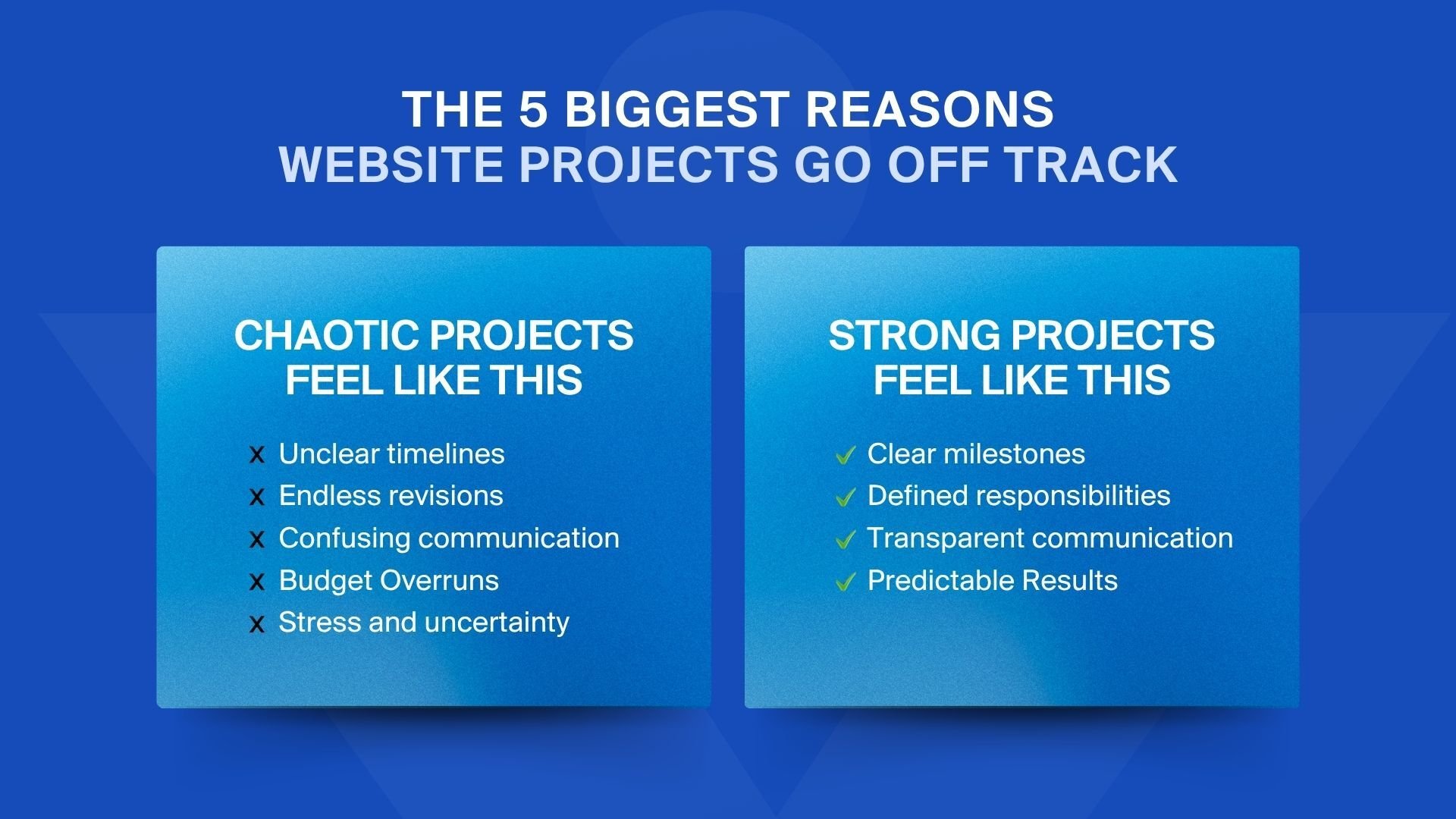
If your website project feels chaotic, something's wrong with the process, not your team or the agency's talent.
Strong website projects are collaborative but structured. You should always know what's happening, what's next, and what you're responsible for providing. Uncertainty and confusion are red flags, not normal parts of the process.
A well-run website project gives you:
- Clear milestones with defined deliverables at every stage
- Transparent communication about progress and any issues
- Defined responsibilities so everyone knows what they're accountable for
- Approval checkpoints before the project moves forward
The best agencies don't just make websites. They manage projects strategically, anticipate common problems before they occur, and create frameworks that prevent the delays and scope expansion that plague most redesigns.
If you're constantly surprised by what's happening next, if feedback processes feel disorganized, or if you're unclear what you're supposed to be doing, the problem is process, not people.
Why Website Projects Go Over Budget or Off Schedule
Most delays aren't caused by technical problems or creative disagreements. They're caused by operational failures in how the project is structured and managed.
Undefined Scope
Projects without clearly documented goals and deliverables inevitably expand beyond their original boundaries. When expectations aren't written down and agreed upon, every stakeholder operates from different assumptions about what's included.
Scope definition isn't just a list of pages. It's documented agreement on goals, functionality, deliverables, responsibilities, and what's specifically excluded from the project.
Mid-Project Changes
New requests introduced after approval stages are the primary cause of timeline and budget expansion. Each change creates cascading effects on design, development, testing, and launch preparation.
The problem isn't that changes are inherently bad. It's that they're introduced without understanding their impact. Adding a booking system halfway through development isn't a small tweak. It affects architecture, testing requirements, and potentially requires rework of completed sections.
Delayed Feedback Cycles
When stakeholders take three weeks to review and approve design mockups that were supposed to get feedback in three days, every subsequent phase gets delayed. These delays compound throughout the project.
Slow approvals don't just push back the launch date. They create idle time where the development team moves to other projects, which then creates scheduling conflicts when approvals finally come through.
Missing Content and Assets
Development can't proceed without content. Design can't be finalized without real copy and images. Yet content preparation is consistently underestimated or completely overlooked during planning.
A website scheduled to launch in 12 weeks sits 80% complete at week 20 because the client still hasn't provided final copy for service pages, case studies, or team bios. The website is built and functional, but it can't launch with Lorem Ipsum placeholder text.
Too Many Decision-Makers
Projects with five stakeholders who all have approval authority rarely reach consensus efficiently. Conflicting feedback, competing priorities, and endless revision cycles emerge when decision-making responsibility isn't centralized.
One executive wants minimal text and large images. Another demands comprehensive explanations. A third insists on specific features that contradict the agreed-upon strategy. Without a clear decision hierarchy, these conflicts paralyze progress.
Website Scoping Checklist for Non-Technical Teams
Good scoping removes uncertainty before development begins. Here's a practical framework that works even if you've never managed a website project before.
Define Business Goals First
What should this website accomplish for your business? Be specific. "Better online presence" isn't a goal. "Generate 50 qualified leads per month from organic search" is a goal.
Common goals include lead generation with specific volume targets, brand positioning for new market segments, e-commerce revenue from specific product lines, recruitment for specific roles, or awareness building with measurable reach metrics.
Your goals determine everything else. A lead-generation website needs different functionality than an e-commerce platform. A recruitment-focused website prioritizes different content than a brand awareness campaign.
Identify Required Pages
List every page your website needs. Don't assume the agency will figure this out. You know your business better than they do at this stage.
Core pages typically include homepage, service or product pages, about page, contact page, and potentially blog or resources section. But your business might need case studies, team profiles, portfolio sections, FAQ pages, or industry-specific landing pages.
Be comprehensive. It's far easier to remove pages during planning than to add them during development.
Clarify Functionality Needs
What does your website need to do beyond displaying information? This is where many projects encounter scope surprises.
Common functionality include:
- Contact forms with specific fields
- CRM integrations
- Booking or scheduling systems
- E-commerce and payment processing
- Membership or login areas
- Custom calculators or interactive tools
Each functional element affects timeline, complexity, and budget. Documenting these upfront prevents "oh, we also need..." surprises mid-project.
Gather Brand and Content Assets
Collect everything the agency will need: current logo files, brand guidelines, existing messaging and value propositions, photography and visual assets, current website copy you want to preserve or modify, and any industry-specific requirements or compliance needs.
Missing assets create delays. If you don't have professional photography, plan for that. If your messaging needs refinement, budget time and potentially external copywriting support.
Define Success Metrics
How will you know if the website is successful six months after launch? Establish measurable criteria.
Metrics might include conversion rates for specific actions, lead volume and quality, organic traffic growth, engagement metrics like time on page or pages per session, or e-commerce revenue and average order value.
These metrics guide design and development decisions. A website optimized for conversions looks different from one optimized for engagement or brand awareness.
Complete this scoping checklist before talking to agencies. Walking into initial conversations with clear answers accelerates the planning phase and produces more accurate proposals.
How to Avoid Scope Creep in Website Projects
Scope creep is preventable with the right frameworks and discipline.
Lock Core Requirements Early
Define must-haves versus nice-to-haves during planning. Must-haves are non-negotiable for launch. Nice-to-haves can become phase two.
Not everything needs to launch at once. Get the essentials live first everything else can follow.
Use Milestone-Based Approvals
Break the project into distinct phases with formal approval gates. Once you approve the sitemap and functionality, that phase is locked. Design happens within that approved scope.
This prevents endless revision loops where earlier decisions keep getting reopened. You can't approve the wireframes and then request fundamental structural changes during visual design.
Separate Strategy From Expansion Requests
When new ideas emerge mid-project (and they will), capture them for future phases rather than forcing them into the current timeline.
Create a "phase two" document where good ideas get documented for post-launch implementation. This validates stakeholder input without derailing the current project.
Centralize Feedback
Designate one person to collect, consolidate, and deliver all stakeholder feedback. The agency shouldn't receive conflicting input from five different people.
This person reviews feedback from all stakeholders, resolves internal conflicts, and provides unified direction. It prevents the agency from trying to satisfy contradictory requirements.
Maintain Clear Documentation
Every decision, revision, and approval should be documented in a central project tracker. When questions arise about what was agreed upon, documentation provides clarity.
This isn't bureaucracy. It's protection for both you and the agency. "I thought we agreed on..." conversations waste time that documentation prevents.
Budget Planning for Website Redesign Projects
Understanding where costs come from helps you budget accurately and make informed tradeoffs.
Website projects typically include these cost components:
Strategy and Discovery: Research, competitive analysis, sitemap development, user flow planning, and requirements documentation. This phase defines what you're building and why.
UX and Design: Wireframes showing structure and functionality, visual design applying your brand, and responsive layouts for different screen sizes.
Development and Integrations: Front-end coding, CMS setup, custom functionality development, third-party integrations (CRM, payment processing, booking systems), and mobile optimization.
Content Creation or Migration: Copywriting if you need it, content migration from your old website, and asset optimization (image compression, formatting).
QA and Launch Support: Cross-browser and device testing, performance optimization, security configuration, and deployment.
Ongoing Maintenance: Hosting, security updates, content updates, and performance monitoring.
The cheapest proposal rarely delivers the best long-term value. Low-cost projects often cut corners on strategy, use template approaches, provide minimal ongoing support, or lack proper testing and optimization.
Strong budget planning reduces expensive surprises by getting accurate scopes upfront, planning for contingencies, and investing in proper process that prevents costly mistakes.
The Website Project Workflow That Actually Works
A structured workflow creates predictability and prevents the chaos that derails projects. Here's the framework that consistently delivers on-time, on-budget results.
Phase 1: Discovery and Strategy
Document business goals, target audience, and competitive landscape. Define success metrics. Create detailed sitemap and functionality requirements. Establish content and asset needs.
This phase aligns everyone before any design or development begins. Skipping or rushing it causes problems throughout the rest of the project.
Phase 2: UX and Wireframing
Design website structure and user flows before visual design. Wireframes show layout, navigation, and functionality without getting distracted by colors and images.
This separation of structure from aesthetics allows you to validate the strategy and functionality before investing in visual design work.
Phase 3: Visual Design
Apply brand identity to the approved structure. Create high-fidelity mockups showing the actual look and feel. Refine based on feedback before development begins.
Visual design approval is a gate. Once approved, structural changes become expensive because they require reworking both design and the development that follows.
Phase 4: Development
Build the website according to approved designs. Implement functionality and integrations. Ensure responsive behavior across devices. Populate content.
Development works efficiently when design is truly finalized. The most expensive delays happen when design changes are requested during development.
Phase 5: QA and Launch
Test across browsers, devices, and user scenarios. Optimize performance. Configure security. Deploy to production. Monitor for any post-launch issues.
Proper QA prevents launching with broken functionality, poor mobile experience, or performance problems that damage user experience.
Phase 6: Ongoing Optimization
Track performance against success metrics. Make iterative improvements based on user behavior. Update content. Maintain technical health.
Launch isn't the finish line. The best websites improve continuously based on real user data and business evolution.
What a Strong Web Design Agency Actually Provides
The right agency partnership reduces complexity instead of adding to it.
Beyond design and development execution, a strong agency partner delivers:
- Strategic planning: clear goals and a defined path to achieve them
- Process management: keeping the project on track without you micromanaging
- Timeline accountability: realistic schedules and early communication about risks
- Risk mitigation: anticipating common problems before they happen
- Long-term support: improving the site after launch, not just delivering it
When evaluating agencies, ask about their process, not just their portfolio. Beautiful work means nothing if the project that created it was six months late and 50% over budget.
Great Website Projects Are Built on Clarity
Website projects succeed through structure, not improvisation. Clear scoping prevents delays and budget overruns. Organized workflows reduce stress and accelerate decision-making. Strategic partners guide you through the process instead of making you figure it out alone.
A website redesign shouldn't feel like navigating unknown territory without a map. It should feel guided, predictable, and collaborative.
The businesses that complete successful redesigns aren't working with more talented designers or developers. They're working with partners who have structured processes that prevent the chaos derailing everyone else's projects.
Ready to plan a website project that actually stays on track? Schedule a free strategy call and we'll walk you through exactly how we structure projects to prevent delays, scope creep, and budget surprises. You'll see our process, understand what to expect, and know exactly what you're responsible for at each phase.
Website projects don't have to be stressful. With the right process, they're straightforward and predictable from start to finish.