
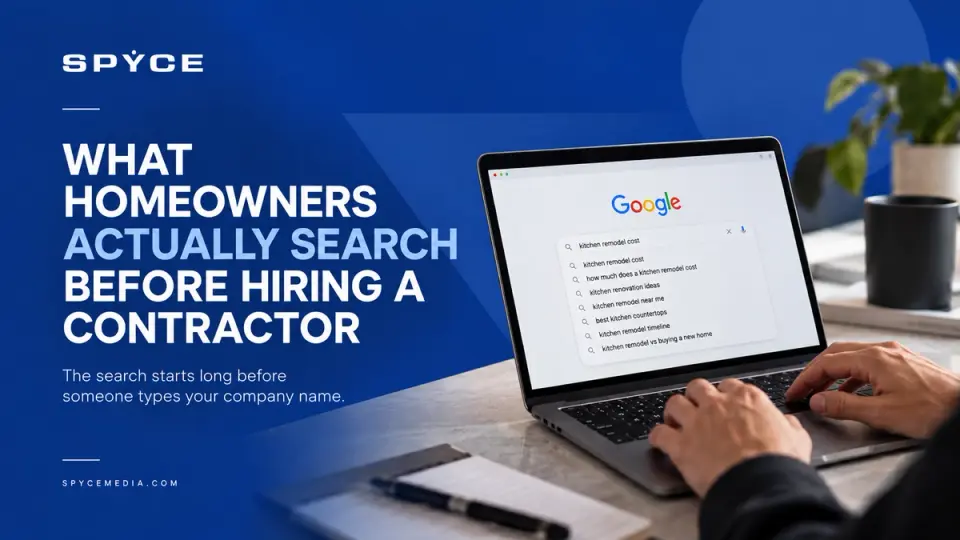
Nobody starts by searching your company name. They start with a problem.
Long before a homeowner types the name of a contractor into Google, they're typing something else entirely. A question. A worry. A project they don't fully understand yet.
They search things like "how much does a roof replacement cost," "signs I need a new roof," "how long does a kitchen remodel take," or "best flooring for a busy family." They compare materials. They research timelines. They read reviews. They quietly evaluate companies in their area, often without ever visiting a single website that mentions a company name, because at that stage, they don't know which name they're looking for yet.
This is the part most contractor websites miss entirely.
If your website is built only around the services you sell, you're only showing up for the homeowners who already know exactly what they want and exactly who they're looking for.
Everyone else, the much larger group still trying to understand their own situation, never finds you at all.
Understanding homeowner search behavior isn't just an SEO tactic. It's a map of how real buying decisions actually happen, and building your website around that map is what separates contractors who get found early from contractors who get found last, if at all.
The goal was never to rank for every possible phrase. It's to understand what a homeowner is genuinely trying to accomplish with each search, and to meet them there with something useful. That's the foundation of effective SEO for contractors and a strong home service SEO strategy.
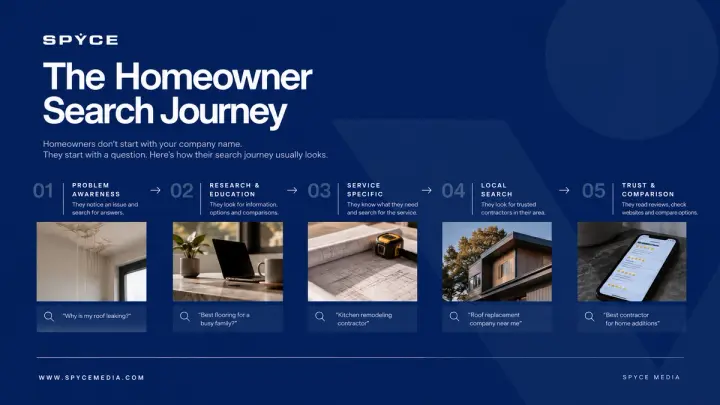
Stage One: Homeowners Start With a Problem, Not a Contractor
Before a homeowner knows which company they want to hire, they usually need to understand what's actually wrong, and what their options even are.
A roof starts leaking. A kitchen stops working for the family that's outgrown it. A bathroom starts to feel embarrassing to show guests. A storm tears through and leaves damage nobody planned for. A renovation that seemed simple on paper turns out to be far more complicated in practice.
The very first search is almost never about the company that will eventually fix it. It's about the problem itself.
A homeowner in this stage might search:
- Why is my roof leaking?
- How do I know if my roof needs to be replaced?
- How long does siding last?
- What are the signs of foundation problems?
- How much space do I need for a home addition?
- Is it better to remodel or move?
- How long does a bathroom renovation take?
None of these are "hire a contractor" searches yet. But don't dismiss them as low value, because this is precisely where trust gets built before a single phone call happens.
Why the earliest research matters most
When your website answers the question a homeowner is asking right now, your business quietly becomes part of their research process, often weeks before they've narrowed down any companies at all.
That doesn't mean every informational search converts into a lead immediately. It means you get there first. You demonstrate real knowledge instead of asking for trust you haven't earned yet.
A roofing company that publishes a genuinely useful article on common causes of roof leaks, then connects that explanation naturally to its repair and replacement services, isn't just creating content. It's making itself the obvious next call once the homeowner is ready.
The service should always feel like the natural next step in the conversation you've already started, never like an advertisement dropped into someone else's research.
This is where understanding homeowner search intent can make a difference. Your content should answer what the homeowner is actually trying to figure out, not simply target a list of contractor SEO keywords.
Stage Two: Homeowners Know the Service They Need
As a homeowner learns more, their searches sharpen. The vagueness becomes specific.
Instead of researching a general problem, they start looking for a particular type of service:
- Kitchen remodeling contractor
- Roof replacement company
- Bathroom renovation services
- Home addition contractor
- Window replacement contractor
- Storm damage repair
- Custom home builder
This is exactly where a single, catchall "Services" page starts costing you leads. When every offering lives under one generic page, visitors have to do the work of figuring out whether you're actually the right fit, and most won't bother.
If kitchen remodeling is something you offer, it deserves its own page, one that explains the service in real depth. What types of projects you handle. What problems do you actually solve? What the process generally looks like. What someone should consider before reaching out, and exactly what to do when they're ready.
What a genuinely useful service page needs to answer
A strong service page should make it unmistakably clear:
- What the service includes
- What types of projects you take on
- Who the service is actually suited for
- What problems it solves
- What factors influence the project
- What homeowners should think through beforehand
- How to request an estimate or consultation
That's a fundamentally different exercise than repeating a keyword phrase six times and calling it done. Your content should prove you understand the homeowner's actual situation, not just that you understand how search engines rank pages.
This is also where contractor website SEO matters. Your service pages should be structured around the services homeowners are actually searching for and the questions they have before contacting you.
Cost Is the Question Nobody Wants to Ask Out Loud, So They Ask Google Instead
Cost sits near the top of nearly every homeowner's research, and searches like "how much does a bathroom remodel cost" or "roof replacement cost" almost always mean someone is quietly checking whether this project even fits their budget before they let themselves get excited about it.
Plenty of contractors avoid pricing content altogether, and the logic makes sense on the surface: pricing varies wildly from project to project, so why publish something that might mislead someone?
Here's the problem with that logic. Avoiding the topic doesn't make the question disappear. It just means the homeowner finds the answer somewhere else, possibly from a competitor, possibly from a source with no real expertise at all.
You don't need to publish a fixed number. What you need to do is explain what actually drives the cost of a project: size, existing conditions, material choices, structural changes, labor, accessibility, permits, customization, and the dozen other variables that make every project genuinely different.
Give homeowners context, not a number that will disappoint them later
A remodeling company can explain, in plain language, why two bathroom renovations can land at completely different price points, rather than throwing out one number that sets an unrealistic expectation from the start.
That approach gives the homeowner a far more honest picture of what actually goes into the project, and it opens a natural door to explaining why a real consultation or estimate matters.
Most of the time, the real question underneath "what's the price" isn't actually about the exact dollar figure. It's this:
"What should I expect before I even talk to a contractor?"
Your website's job is to answer that honestly, before anyone picks up the phone.
Once They Start Comparing Companies, Homeowners Are Searching for Reasons to Trust You
Something shifts once a homeowner moves from researching the project to researching specific companies. They're no longer trying to understand what needs to be done. They're deciding whether you, specifically, are worth the risk.
This is where reviews, credentials, project history, and reputation carry real weight. A homeowner might search your company name followed by "reviews," or land directly on your site to size up your past work before deciding anything.
Make that evaluation effortless. Show real projects instead of vague claims about experience. Feature genuine reviews. Be specific about where your expertise actually lies. Keep every detail current, because outdated information reads as a red flag even when nothing is actually wrong.
Project photography does something written claims simply can't. It lets homeowners see the actual work you do, rather than take your word for phrases like "quality craftsmanship," which every competitor is also using.
The question underneath the trust research
Before reaching out, most homeowners are essentially asking themselves one thing:
Can this company handle a project like mine, and do I feel genuinely comfortable moving forward with them?
Your website's only job at this stage is to make that answer obvious. Getting someone to your site is only half the equation. What they find once they arrive determines whether they keep researching your company, or quietly move on to the next tab.
Homeowners Want to Know What Happens After They Say Yes
A major home project touches planning, scheduling, preparation, communication, and real disruption to daily life. It's only natural that homeowners have questions about what happens the moment they commit.
They wonder how long the work will take. Whether permits are involved. How preparation works. Who makes which decisions. How communication happens once the project is underway.
Every one of those questions is an opportunity, not an obstacle.
Rather than leaving homeowners to guess, walk them through it. A remodeling company can lay out the typical stages, from the first consultation and planning phase through material selection, preparation, construction, and final walkthrough.
The exact process will differ by company and project, but the underlying principle never changes: uncertainty is the enemy of conversion, and explaining what to expect is how you remove it.
The best content ideas are already sitting in your inbox
If you're ever short on content ideas, stop guessing and start listening. Pay attention to the questions your customers ask you directly, during consultations, over the phone, in emails.
If the same question comes up again and again, that's not a coincidence. That's a signal your website should be answering it. Those recurring questions can become blog articles, service page sections, project guides, planning resources, process explanations, or comparison content.
You don't need to imagine what your audience wants to read. They're already telling you.
For contractors, this can also create opportunities for SEO services for home service businesses because the questions customers ask can help shape the content strategy around real search intent rather than assumptions.
Timing and Materials Shape the Decision Too
Homeowners also research when to start a project and which materials actually make sense for their property.
Depending on the work, they might want to know whether a project fits better in a particular season, how long it will realistically take, what preparation is required, or how long certain materials tend to last before needing attention again.
Material research gets specific fast. A homeowner might compare roofing materials, flooring, siding, countertops, or windows based on appearance, maintenance, durability, performance, and budget, often across several browser tabs at once.
This gives you a real opening to demonstrate expertise without turning every piece of content into a sales pitch. Explain the trade offs honestly. Walk through the advantages and limitations of each option. Make clear that the right choice depends on the property, the project, and the homeowner's own priorities.
That kind of honest, practical information is exactly what earns trust, and it naturally connects those decisions back to the services you offer.
Local Searches Are How Homeowners Find Someone Who Actually Serves Them
For most contractors, location isn't a detail. It's the deciding factor. A homeowner doesn't need a remodeling contractor in the abstract. They need one who actually shows up in their neighborhood.
That's why so many searches combine a service with a location:
- Roofing contractor in [Your City]
- Kitchen remodeling in [Your City]
- Bathroom renovation near [Your City]
- Home addition contractor in [Region]
- Contractor near me
Your website needs to answer, instantly, where you work and what you offer there.
This is where local SEO for contractors becomes especially important. When homeowners use local contractor searches, they aren't just looking for information. They're trying to find a business that can actually serve them.
Location pages only work when they say something real
Location pages create genuine value when they actually explain something about your company and the community you serve. Dozens of nearly identical pages with nothing changed but the city name don't help anyone, and search engines have gotten very good at noticing the difference.
Explain the services available in each area. Be specific about the communities you actually serve. Keep that information consistent everywhere it appears online.
Local content exists to answer one question, fast: "Does this contractor actually serve my area?" Answer it clearly, and you've removed one of the biggest silent barriers between a homeowner and picking up the phone.
Comparison Searches Mean Someone Is Getting Close to a Decision
As homeowners get more serious, their research shifts from general education into direct comparison. They start weighing contractors against each other, comparing materials, debating repair versus replacement, or trying to figure out what actually matters when choosing a company.
At this point, they're no longer gathering information. They're evaluating options side by side.
You can meet them here by explaining, honestly, what actually matters when comparing contractors: relevant project experience, communication, reviews, credentials, written proposals, clear expectations, and genuine familiarity with the specific type of work involved.
The goal isn't to declare yourself better than every competitor in the market. It's to give homeowners a real framework for evaluating their choices. When your own website clearly demonstrates those qualities, visitors reach the obvious conclusion on their own, without you ever having to say it outright.
Branded Searches Are the Final Stretch of a Much Longer Journey
Eventually, homeowners search for your company by name. They may have found you through an article, a local search, a referral, a social post, or a review, and now they're verifying you before taking the next step.
They'll pair your business name with terms like reviews, services, projects, location, experience, or contact information.
This moment deserves your full attention, because someone searching for you by name has already moved well past general research. Your website's job here is simple: confirm who you are, what you do, where you work, and how to reach you, without making them dig for any of it.
If someone has already taken the step of searching for you by name, the last thing you want is to make them work to understand what your company actually offers.
The Real Mistake Isn't Bad Keywords. It's Treating Every Search the Same.
The problem was never really about choosing the wrong keywords. It's about failing to understand why the homeowner searched in the first place.
Someone searching "why is my roof leaking" needs something entirely different from someone searching "roof replacement contractor near me." Someone researching "bathroom remodel cost" is in a different headspace than someone looking up reviews of a specific company. And someone searching your business name by name is already much closer to calling you than either of them.
This is exactly why a strong SEO for contractors strategy has to account for different stages of the buying journey, not just different keywords.
Instead of building a list of phrases and stuffing pages around them, build your content around the actual questions your customers need answered:
- What problem is the homeowner trying to solve?
- What service are they researching?
- What concerns might stop them from moving forward?
- What information would help them compare their options?
- What do they need to know before contacting a contractor?
- What do they need to know after they've already found your company?
Those answers should shape every service page, every article, every project gallery, every local page, and every conversion path on your website.
Your Website Should Move the Way Homeowners Actually Make Decisions
A strong contractor website does more than pull in traffic. It guides visitors from uncertainty toward a confident decision.
A single homeowner might discover an article about their problem, click into a related service page, browse project photos, read a handful of reviews, check whether you serve their area, research costs, and only then request an estimate. That journey can span several searches and several visits, sometimes over days or weeks.
Your content needs to be ready for every step of it.
The objective was never to make one page rank for everything. It's to build a connected website where different pieces of content answer different questions at different stages of that same journey.
That's the real difference between chasing contractor SEO keywords and building a website that actually supports the way people buy.
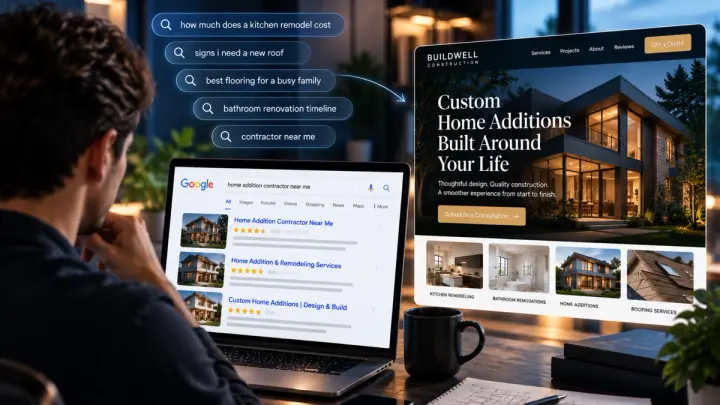
Build Your Contractor Website Around What Homeowners Are Actually Searching For
Homeowner search behavior gives contractors a far more useful lens than keyword volume ever could.
The question was never really "which keywords should we target." The better question, the one worth building your entire content strategy around, is:
"What is this homeowner trying to understand, compare, or decide when they make this exact search?"
Once that question drives your strategy, your content stops feeling like SEO filler and starts feeling like something genuinely useful, which is exactly what search engines have been rewarding all along.
Build service pages around specific needs. Answer the cost and process questions honestly. Explain materials and trade offs with real expertise. Create local content that says something true. Make your reviews and project history easy to find. Then give every important page a clear, obvious next step.
That's how SEO for contractors stops being just a traffic strategy and starts becoming part of how your business actually helps homeowners understand their options, evaluate your expertise, and decide you're the right call to make.
Ready to Build a Website Around How Your Customers Actually Search?
If your website is built mainly around a list of services and a handful of keywords, there's a good chance it's missing most of the questions homeowners are asking before they're anywhere close to ready to hire.
A strategic approach uncovers those questions, organizes them into genuinely useful content, and builds a website that supports the homeowner from their very first search all the way through the decision to contact your company.
Build your contractor website around what your customers are actually searching for.
Book a call with SPYCE → (link: https://cal.com/spycemedia/website-care-15-min )