

A service page should help Google understand the service and help the customer choose you.
A homeowner searching for a contractor usually has a specific need in mind. They might need a roof replacement, an HVAC repair, or a kitchen renovation. They are not simply looking for a company that offers a long list of services. They want to find someone who understands the work they need done.
Your website should make that connection clear.
One common problem we see on contractor websites is that every service is listed on a single page. The page might mention roofing, siding, remodeling, repairs, and installations, but provide very little information about any of them.
That can make it difficult for potential customers to understand what the company actually specializes in. It also gives search engines less context about the individual services the business provides.
A well-built service page does more than mention a service. It explains what the work involves, who it is for, where the company provides it, and why someone should consider hiring that business.
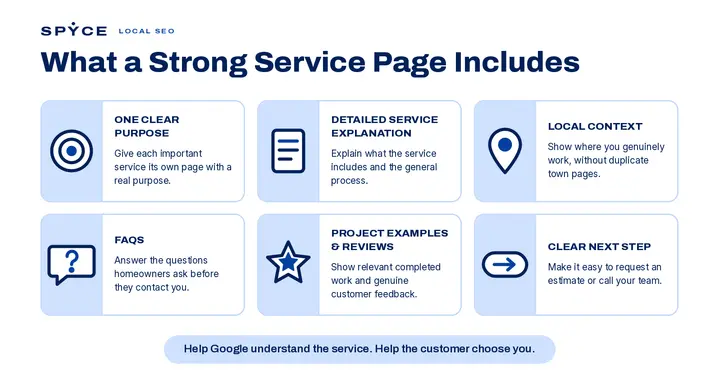
Here's how to build service pages that support local visibility and help turn website visitors into inquiries.
1. A Service Page Should Do More Than List What You Offer
Think about the difference between a page that says, "We offer roof replacement and roof repair," and one that explains each service in detail.
The first tells visitors what the company does. The second helps them understand whether the company can solve their particular problem.
A general services page can be useful as an overview. It gives visitors a place to explore the company's offerings. However, it may not provide enough information when someone is searching for one specific service.
For example, someone looking for roof replacement may want to know what the process involves, what materials are available, and what factors affect the project. Someone looking for roof repair may be more concerned about identifying damage, preventing further issues, and understanding whether a repair is possible.
These are different customer needs. They deserve different explanations.
Dedicated service pages give each offering room to address those questions. They also help search engines understand the individual services your company provides.
This is an important part of SEO for contractors. Your website should communicate what your business does clearly, rather than expecting visitors and search engines to piece everything together from a single page.
The goal is not to create as many pages as possible. Each page should serve a real purpose and provide information that is useful to the person searching.
2. Give Every Important Service Page One Clear Purpose
Before creating new pages, look at the services your company currently offers.
Which services are most important to your business? Which projects do you want more inquiries for? Are there services that have different processes, customer concerns, or project requirements?
These questions help determine which offerings deserve dedicated pages.
For example, a roofing company might create separate pages for:
- Roof replacement
- Roof repair
- Roof inspections
- Commercial roofing
A general contractor might separate:
- Kitchen remodeling
- Bathroom remodeling
- Home additions
- Whole-home renovations
Each service involves different considerations. Giving them individual pages allows the business to explain those differences instead of squeezing everything into a generic description.
However, not every variation needs its own page.
If two services are essentially the same offering with slightly different wording, creating separate pages may result in repetitive content. That does not necessarily make the website more useful.
Start with the services that are important to your business and have distinct customer needs. Build those pages properly before expanding into smaller variations.
Expert tip: Your website does not need dozens of service pages to be effective. A smaller collection of useful, detailed pages is more valuable than a large collection of repetitive ones.
3. Match the Content to What Homeowners Are Searching For
A strong service page starts with understanding what someone wants to know when they search.
Not every homeowner searching for a contractor is at the same stage of the decision-making process.
Some are researching a problem. Others already know the service they need and are comparing companies. Your page should provide information that matches the reason someone landed on it.
Consider these two searches:
- Roof replacement
- Roof repair
Both relate to roofing, but the person searching for each service may have different questions.
Someone considering roof replacement might want to understand material options, project timelines, preparation, and what affects the overall cost.
Someone looking for roof repair may want to know what types of damage can be addressed, how the issue is assessed, and whether the problem requires immediate attention.
A page that treats both searches exactly the same misses an opportunity to provide relevant information.
Include the service name naturally in the page title, main heading, and supporting copy. Use related terms where they make sense, but avoid repeating the same phrase in every paragraph.
Search engines need context, but homeowners need clear explanations.
Instead of writing content just to include keywords, think about the questions someone would ask before contacting your company. Those questions should guide the page.
4. Explain the Service in Enough Detail
One of the biggest mistakes contractors make is writing service descriptions that are too general.
A page might say:
"We provide professional kitchen remodeling services using quality materials and experienced workmanship."
There is nothing necessarily wrong with that statement, but it does not tell a homeowner very much.
What does the remodeling service include? Do you handle cabinetry, countertops, flooring, and layout changes? What happens before construction begins? What should the homeowner prepare for?
A useful service page should answer these questions.
Start by explaining what the service includes. Describe the types of projects your company handles and the situations in which a homeowner might need the work.
Then explain the general process.
For a kitchen remodeling page, you might discuss the initial consultation, planning, material selection, preparation, construction, and final walkthrough. You do not need to publish every operational detail, but giving visitors a general idea of what to expect can make the decision feel less overwhelming.
Include relevant considerations, too. Depending on the service, these might involve:
- Material and product options
- Project preparation
- Expected timelines
- Access requirements
- Factors that affect project scope
- Potential permitting or installation considerations
Be careful not to make promises that cannot apply to every project. Timelines and pricing can vary depending on the property's condition, materials, availability, and complexity.
The objective is to provide enough information for someone to understand the service and decide whether they should take the next step.
5. Add Local Context Without Creating Duplicate Pages
Local relevance matters when your business serves customers in specific communities.
A homeowner searching for a contractor wants to know whether that company actually works in their area. Your service pages should make that information easy to find.
Start by identifying the locations where your company genuinely provides the service. You can mention your service area naturally within the page and include relevant local project examples when available.
For example, a remodeling company serving several communities might explain its experience with the types of homes and projects it commonly handles in those areas.
Real project photographs, customer feedback, and examples of completed work can provide useful local context. They also give visitors a better understanding of the company's experience.
However, avoid creating multiple pages that only change the town name.
If you have five pages with nearly identical descriptions and the only difference is the location mentioned in the heading, those pages are unlikely to offer much additional value to visitors.
A separate location page makes sense when the business has meaningful information to share about that area. This might include relevant projects, service availability, customer experiences, or other details that genuinely distinguish the page.
This is where local SEO for general contractors requires more than inserting city names into website copy. The location information should reflect where the business operates and the work it actually performs.
Keep service areas accurate and consistent across your website. Do not claim to serve locations where your team cannot realistically take on projects.
6. Use FAQs to Address Questions Before Customers Ask
Your sales conversations are a useful source of website content.
Think about the questions homeowners regularly ask during phone calls, consultations, and estimates. Many of those questions belong on your service pages.
For a roof replacement page, common questions might include:
- How do I know if my roof needs replacement?
- What roofing materials are available?
- How long does a typical roof replacement take?
- Do I need to prepare my property before work begins?
For an HVAC installation page, questions might include:
- How do I know what system is right for my home?
- What factors affect installation costs?
- How long does installation usually take?
- What should I expect during the process?
These questions help visitors understand the service before contacting your company.
Keep your answers direct. If a question can be answered in two or three sentences, there is no reason to turn it into a long explanation.
You can also use FAQs to clarify things that are often misunderstood, such as what is included in an estimate, whether an inspection is required, or what happens after someone submits an inquiry.
Do not add questions simply to make the page longer. Every FAQ should address a real concern or provide information that helps someone make a decision.
7. Build Trust With Project Examples and Customer Feedback
A detailed service description tells visitors what your company can do. Project examples help show that you have experience doing it.
This is especially important for contractors because homeowners are making decisions that involve their property, time, and often a significant investment.
Whenever possible, include relevant completed projects on the corresponding service page.
For example, a kitchen remodeling page could feature a completed kitchen renovation. Instead of showing photographs alone, provide a little context:
- What did the homeowner want to improve?
- What work did your team complete?
- Were there any particular project considerations?
- What was the result?
You do not need to write a full case study for every project. Even a short description can help visitors understand the scope of your work.
Use genuine photographs and make sure you have permission to publish them. Relevant images are more useful than generic stock photography because they show the actual work your company has completed.
Customer testimonials can also support the page. Choose feedback that relates to the service being discussed, especially when it mentions communication, workmanship, project management, or the overall customer experience.
The goal is to give homeowners reasons to feel confident about contacting your company.
8. Connect Service Pages Through Internal Links
Your service pages should not exist as isolated parts of your website.
Internal links help visitors move between related information and make it easier to discover other relevant pages.
For example, a roof replacement page could link to:
- A completed roof replacement project
- A related roof inspection service
- A relevant article about roofing materials
- The company's contact page
A kitchen remodeling article could also link to the kitchen remodeling service page when readers are ready to explore professional help.
Use descriptive link text so visitors understand what they will find when they click. Instead of using "click here" everywhere, use phrases such as "view our completed kitchen remodeling projects" or "learn more about our roof replacement services."
Make sure important service pages are accessible through your website's navigation or other relevant pages. Visitors should not have to search through several unrelated sections to find the service they need.
Internal linking also helps search engines understand how your pages relate to one another.
Keep the links relevant. Adding too many links can distract visitors from the main purpose of the page, which is to help them understand the service and take the next step.
9. Optimize the Page Experience and Make the Next Step Easy
Even useful content can underperform when the page is difficult to navigate or contact information is hard to find.
Once the content is in place, review how the page works as a whole.
Start with the page title and meta description. These should accurately describe the service and give people a clear reason to visit the page from search results.
Use one clear main heading and organize the rest of the content with supporting headings. This makes the information easier to scan, especially for visitors who are looking for answers to specific questions.
Pay attention to mobile experience, too. Homeowners may be browsing your website from their phones, so text should be readable, images should load properly, and important information should not be difficult to access.
Your calls to action should also be clear.
Tell visitors what they can do next. Depending on your business, that might be requesting an estimate, scheduling a consultation, or calling your team.
Make phone numbers clickable on mobile and keep inquiry forms straightforward. Only ask for information you actually need to begin the conversation.
Finally, test your contact forms and phone links regularly. A service page can attract relevant visitors, but if the inquiry process does not work, those opportunities can be lost.
A Better Service Page Starts With the Customer
A service page that supports local visibility is not built around keywords alone.
It needs to explain the service clearly, match what homeowners are looking for, provide relevant local information, and demonstrate that your company has the experience to do the work.
It also needs to make contacting your business straightforward.
If your website currently lists all your services on one page, start by identifying the offerings that matter most to your business. Review what each page should communicate, what questions it needs to answer, and what evidence can help homeowners feel confident in your work.
Remember, ranking is only part of the goal. The right page should attract relevant visitors and help them understand why your company may be the right choice.
Need a second look at your contractor website?
SPYCE Media helps contractors improve their website structure, content, and search visibility. We can review your existing service pages, identify gaps, and build a clearer website experience that supports your business goals.
Let's make sure your website is doing more than listing what you offer. It's helping the right customers find you and take the next step.