
If you run a contracting or home service business, you probably already know that showing up on Google matters. But when you're busy managing jobs, answering calls, preparing estimates, and coordinating your team, it's fair to ask: Do I really need a website if I already have a Google Business Profile?
It's a reasonable question.
Your Google Business Profile can help customers discover your company, see your reviews, check your hours, and find your contact information. Your website gives them more room to understand your services, explore your work, and decide whether you're the right contractor for their project.
They serve different purposes, and neither automatically replaces the other.
Think about the last time you hired a service provider. Finding a business was only the beginning. You probably wanted to know what they offered, whether they had relevant experience, and how to get in touch before making a decision.
Your potential customers go through a similar process.
For contractors, effective local SEO for contractors isn't simply about appearing in search results. It's about making sure the information customers find helps them move from discovering your business to feeling confident enough to contact you.
Let's break down what each asset does, how they work together, and where you should focus if your current online presence isn't bringing in the inquiries you want.
The Short Answer: They Have Different Jobs
Your Google Business Profile and your website are two different parts of your online presence.
Your profile helps people discover and quickly assess your business through Google Search and Maps. Your website gives them a more complete picture of your services, experience, process, and approach.
Here's the distinction:
- Google Business Profile: Helps eligible local businesses appear in relevant local search experiences and gives potential customers quick access to important business information.
- Your website: Provides detailed information about your services, showcases your work, answers customer questions, and guides visitors toward contacting you.
- Together: They help customers find your business, evaluate whether you're a good fit, and take the next step.
Imagine your roofing company appears in local search results. A homeowner sees your name, checks your reviews, and clicks through to your website.
If your website clearly explains your roof replacement services, shows real project examples, and makes requesting an estimate easy, the homeowner has more information to work with.
But if the website is outdated, difficult to navigate, or vague about what you offer, that opportunity can be lost.
Visibility gets your business considered. Relevant information and a clear customer experience help people decide whether to contact you.
That distinction should guide how you invest in both assets.
What Your Google Business Profile Actually Does
Your Google Business Profile is the business information that can appear when people search for your company or relevant local services on Google Search and Maps.
Depending on your business and the features available, customers may see your business name, category, service area, hours, phone number, website link, photos, reviews, and other details.
For someone looking for a contractor, these details answer immediate questions.
Does this business serve my area? Does it offer the service I need? Can I call? What have other customers said about their experience?
The profile helps people find those answers without having to visit several different websites.
Keep the information accurate
Start with the basics:
- Choose the most appropriate business category.
- Keep your phone number, hours, and website link current.
- Make sure your service information accurately reflects what you offer.
- Add useful, genuine photos of your business and work.
- Develop a consistent process for requesting honest customer reviews.
These details might seem small, but they affect the experience people have when they encounter your business.
For example, if your profile shows an incorrect phone number, a potential customer might never reach you. If your listed services don't reflect what you currently offer, you could miss relevant inquiries or attract the wrong ones.
Google explains that local results are primarily based on relevance, distance, and prominence. You can't guarantee a particular position simply by completing your profile, but accurate information gives customers and Google a clearer understanding of your business.
For companies investing in local SEO for HVAC companies or local SEO for general contractors, maintaining a complete and accurate profile is an important part of the overall strategy.
However, your profile has limitations. It isn't designed to replace the depth and flexibility of a dedicated website.
That brings us to the other half of the equation.
What Your Website Does That Your Profile Can't
Your website gives you space to explain your business in a way a short business listing simply can't.
You can build dedicated pages for your core services, explain your process, showcase completed projects, introduce your team, and answer questions customers often ask before hiring a contractor.
More importantly, you can organize that information around the different needs of your customers.
Consider a general contractor offering kitchen remodeling, bathroom renovations, and home additions.
A homeowner planning a kitchen renovation probably wants to see kitchen projects, understand the remodeling process, and learn what happens when they request an estimate.
Someone planning a home addition has different questions.
If all those services are squeezed onto one generic page, both customers may struggle to find the information they need.
A well-planned website can give each service the attention it deserves.
For example, your website might include:
- A homepage that explains what you do and where you work.
- Individual service pages that describe your core services in detail.
- Project pages that demonstrate relevant experience through real work.
- An About page that introduces your team and approach.
- A Contact page that makes it easy to request an estimate or start a conversation.
This structure is particularly useful when investing in SEO services for home service businesses, because it allows your website to address different customer needs instead of relying on one page to explain everything.
Your website also gives you more control over the customer journey. You can connect related pages, guide visitors toward relevant projects, and make the next step clear.
The goal isn't to publish as many pages as possible. It's to make sure the right information exists when someone needs it.
Discovery vs. Decision: How Customers Use Both
Let's put these two assets into a real-world scenario.
Imagine a homeowner needs a roof replacement and searches for a contractor in their area.
They find several businesses in Google Search or Maps. They look at business details, compare reviews, and perhaps visit a few websites.
One company has an active profile but a website that only says it offers roofing services.
Another has accurate business information, relevant reviews, a dedicated roof replacement page, examples of completed projects, and a clear way to request an estimate.
The second company gives the homeowner more information to evaluate whether it's a suitable choice.
That doesn't guarantee the homeowner will choose it. Pricing, availability, recommendations, and other factors may influence the decision. But the business has made it easier for the customer to understand its offering.
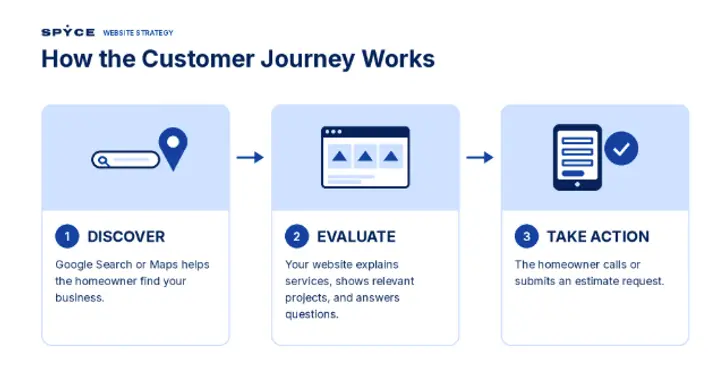
The homeowner calls or submits an estimate request.
Not everyone follows this exact path. Some people call directly from your profile. Others already know your business and visit your website first.
What matters is that both paths work.
Your profile should make it easy to identify and contact your business. Your website should help visitors understand your services and decide whether to move forward.
Expert insight: Don't measure your online presence only by whether people can find you. Consider what happens after they find you. Are they getting the information they need to make a decision?
Use Reviews, Photos, and Project Examples to Build Trust
Hiring a contractor often involves a significant investment. Homeowners want to feel comfortable with the business they choose, especially when the work involves their home.
That's where reviews and visual proof can help.
Your Google Business Profile gives customers a convenient place to read reviews and see photos. Your website gives you room to add context to that proof.
For example, a photo of a completed bathroom renovation is useful. A project page explaining the scope of the renovation, the work completed, and the final result can be even more informative.
The same principle applies to roofing, HVAC, and general contracting.
Rather than relying on broad statements such as “We deliver exceptional results,” show examples that help people understand the kind of work your team actually does.
Keep your photos genuine and your claims accurate. Don't present stock imagery as completed client work, and only publish testimonials you have permission to use.
It's also worth reviewing your profile and website together.
If your profile shows recent projects but your website features outdated services, the overall experience may feel inconsistent. If your website claims to specialize in a particular service but your profile doesn't reflect your current offering, customers may be unsure what you actually do.
Consistency helps people build a clearer picture of your business.
Make the Next Step Obvious
Getting visibility is only part of the job. You also need to make contacting your business straightforward.
Start with your Google Business Profile. Check that the phone number and website link work correctly, and that your listed hours and other business information are accurate.
Then review your website.
Can someone easily find your phone number? Is there a clear way to request an estimate? Does your contact form work on a mobile device?
Small obstacles can create unnecessary friction.
For example, a homeowner may be ready to inquire but leave because the contact button is difficult to find or the form asks for too much information.
Keep calls to action direct and relevant to the service. “Request an Estimate” or “Contact Our Team” is generally clearer than a vague button that doesn't explain what happens next.
Also, test your inquiry process from beginning to end. Submit the form yourself and confirm that the message reaches the right person.
A website can look excellent and still fail at its most important job if inquiries aren't delivered or followed up.
Remember, your website doesn't operate independently of your business. The people, processes, and systems behind it also affect the experience customers receive.
Keep Both Assets Updated and Consistent
Your online presence needs ongoing attention.
Business hours change. Services expand. Phone numbers get updated. New projects are completed. Your website and Google Business Profile should reflect those changes.
Create a simple review process to check:
- Business name and contact information.
- Service descriptions and service areas.
- Website links and contact forms.
- Recent project photos and relevant testimonials.
- Accuracy of your core website pages.
You should also ensure that the business maintains appropriate access to its Google Business Profile. Authorized representatives should be able to manage the listing without relying entirely on a former employee or outside provider.
Your profile and website don't need identical wording. The profile is designed for concise business information, while your website can explain your services in greater depth.
The important thing is that the facts match.
What Should You Fix First?
If both assets need improvement, you don't necessarily have to tackle everything at once. Start with the biggest problem affecting customers.
If customers struggle to find or contact you
Review your Google Business Profile first. Correct inaccurate details, check your business category and service information, and make sure your phone number and website link work.
If visitors need more information before contacting you
Review your website. Improve the pages for your core services, add relevant project examples, explain your process, and make your contact options easier to find.
If both assets are incomplete or inconsistent
Address the basics together. Align your business information, connect your profile to the right website pages, and make sure customers receive a consistent message wherever they find you.
For businesses investing in SEO for contractors, it's useful to review more than rankings alone. Look at website visits, calls, form submissions, and the quality of the inquiries you receive.
If people are finding your business but contacting you about services you don't offer, your service information may need clarification.
If visitors reach your website but rarely inquire, review the page they're landing on, the information it provides, and how clearly it guides them toward contacting you.
These observations help you decide what to improve rather than making changes simply because a competitor is doing something different.
Build a Connected Local Search Presence
Your Google Business Profile and website aren't competing investments. They support different parts of the customer journey.
Your profile helps people discover your business and quickly check essential information. Your website provides the depth, context, and proof that can help them evaluate your services.
When the two are accurate, useful, and connected, you give potential customers a clearer path from finding your business to deciding whether to contact you.
That is the practical foundation of a stronger local search presence.
You don't need to overhaul everything overnight. Start by identifying where customers experience friction, then improve the asset that's most directly responsible for that problem.
And remember: a better online presence isn't just about being visible. It's about helping the right customers understand what you offer and making it easier for them to take the next step.
Help Customers Find You, Then Give Them a Reason to Choose You
If your business relies on local customers, both your Google Business Profile and your website deserve attention.
Keep your profile accurate and useful. Build a website that clearly explains your services, demonstrates your experience, and makes contacting you straightforward. Then review how the two work together as your business grows.
For contractors who already have a profile but aren't getting the inquiries they want, the next improvement may not be more visibility alone. It may be a better website experience once a potential customer arrives.
Want to make your website work harder for your business?
Explore SPYCE Media's website SEO services to see how a more strategic approach to your website can support your online presence and help customers find the information they need.