

Your website might look great. But is it actually helping homeowners find what they need?
Imagine someone needs a roof replacement. They land on your website, click Services, and find one long page listing everything from repairs to installations. There are a few photos, a paragraph about quality workmanship, and a contact button somewhere at the bottom.
They still don't know whether you handle their specific project.
So they leave and check another contractor.
This is one of the most common problems with contractor websites. The issue isn't always the design. It's how the information is organized.
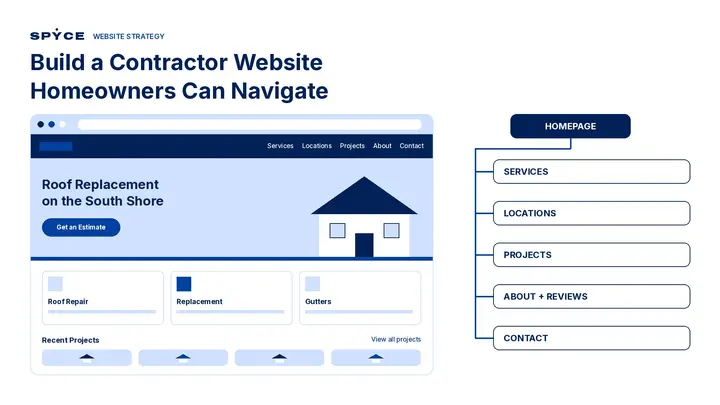
A well-structured website should make three things easy: finding the right service, understanding why your company is a good fit, and taking the next step.
That structure also helps search engines discover and understand your pages.
Whether you're building a website from scratch or considering a contractor website redesign, here's how to organize it around the way homeowners actually search.
Start With How Your Customers Search
Before choosing layouts, colors, or fonts, think about what brings someone to your website.
Most homeowners aren't searching for your company name unless they already know you.
They're searching for a solution.
A homeowner might search for roof repair because they've noticed a leak. Someone else might be comparing contractors for a kitchen renovation. Another person may need an HVAC installation before summer.
These are different needs, and your website should reflect them.
Start by identifying:
- Your primary services and the specific jobs within each service.
- The locations your company genuinely serves.
- The questions customers frequently ask before requesting an estimate.
- The projects you want your company to become known for.
For example, a general contractor offering kitchen remodeling, bathroom remodeling, and home additions shouldn't expect one generic Services page to answer every customer's questions.
Each service has different considerations, expectations, and decision-making factors.
Expert insight: Don't build your website around every keyword you can find. Build it around the services your business actually provides and the questions your ideal customers need answered.
That's how you create a structure that supports both search visibility and qualified inquiries.
Build a Homepage That Helps Visitors Find Their Way
Your homepage is often the first introduction someone has to your company.
It shouldn't require visitors to figure out what you do.
Within a few seconds, they should understand:
- What services you provide.
- Where you operate.
- Why they should consider your company.
- How to contact you.
For example, compare these two headlines.
Generic: Quality Craftsmanship You Can Trust.
Specific: Residential Roofing and Roof Replacement Services in Boston's South Shore.
The second headline immediately communicates the service and location. You can still use brand-focused language, but it should support a clear explanation of the business.
Your homepage should also introduce your primary services with links to their dedicated pages.
If someone needs roof replacement, they should be able to click directly to that service instead of searching through unrelated information.
Include relevant project photography, genuine customer testimonials, and an easy-to-find estimate button.
The goal isn't to fit everything onto the homepage.
It's to help visitors reach the information that matters to them.
Give Every Core Service Its Own Page
This is one of the most important decisions in website design for contractors.
Many contractor websites list all their services on a single page.
While that might seem simpler, it can limit how much useful information you provide about each service.
Consider an HVAC company offering:
- Air conditioning installation
- AC repair
- Heating installation
- HVAC maintenance
Someone researching a new installation has different questions from someone dealing with a broken air conditioner.
Dedicated pages let you address those needs separately.
A strong service page should explain what the service includes, the problems it solves, how your process works, and what customers can expect.
It should also feature relevant project examples, frequently asked questions, and a clear call to action.
For example, a roof replacement page might cover the signs that a roof needs replacing, the materials your company works with, the typical project process, and how to request an inspection or estimate.
This helps customers make an informed decision.
It also gives search engines a clearer understanding of each page's subject.
However, avoid creating multiple pages that say essentially the same thing.
One detailed, genuinely helpful service page is more valuable than several thin pages created only to target slightly different phrases.
Create Location Pages That Offer Real Value
If your company serves multiple cities or towns, location pages can help homeowners understand where you work.
But simply duplicating a page and changing the city name isn't a strong strategy.
A useful location page should provide information specific to that area.
For example, a contractor serving Boston and the South Shore might include relevant projects completed in a particular town, the services available there, and information about how homeowners in that area can request an estimate.
Only include information that is accurate and genuinely relevant.
Don't imply you have a physical office in a location where you don't.
And don't create dozens of location pages for areas your business doesn't meaningfully serve.
Location pages should also connect to relevant service pages.
A homeowner visiting your Plymouth location page should be able to find the specific remodeling or roofing services you offer there.
The objective is to make your service coverage easier to understand, not to manufacture local relevance.
Use Project Pages to Show What Your Company Can Do
Homeowners want more than promises.
They want to see the work.
A project portfolio can be one of the most persuasive parts of a contractor website, especially for businesses where quality, craftsmanship, and experience are important purchasing factors.
But don't treat your portfolio as a random collection of photos.
Give each featured project context.
Explain what the customer needed, what work your team completed, and what made the project noteworthy.
For example, a kitchen renovation project page could explain the original layout challenges, the improvements completed, and the materials or design details involved.
Use authentic photos and accurate descriptions.
When relevant, connect the project to the corresponding service page.
Someone viewing a completed kitchen renovation should have an easy path to learn about your kitchen remodeling services.
This is where your website begins working as a connected system.
Your service pages explain what you offer.
Your project pages demonstrate the work.
And your contact page gives customers a way to start a conversation.
Make Your About, Reviews, and Contact Pages Work Together
Not every visitor is ready to request an estimate immediately.
Some want to know more about your company first.
Your About page is an opportunity to explain who you are, how your team works, and what customers can expect.
Avoid relying entirely on statements like “We provide exceptional service.”
Instead, describe your actual approach.
Do you specialize in a particular type of project? What happens after a customer contacts you? What does your team handle during the process?
Specific information is more useful than generic claims.
Customer reviews can support that information by sharing real experiences.
Your Contact page should then make reaching out simple.
Include your phone number, relevant contact details, service area, and a straightforward inquiry form.
Don't make someone answer 15 questions just to ask whether you're available for a project.
The easier you make the first conversation, the fewer unnecessary obstacles you put between your business and a potential customer.
Plan Your Navigation and Internal Links
Think of your website navigation as a set of directions.
If the labels are confusing, visitors may struggle to find what they're looking for.
Use straightforward menu names such as Services, Projects, About, and Contact.
For larger websites, organize services into logical categories.
Internal links are equally important.
They help visitors move between related information without starting their search again.
For example, a roofing service page can link to a completed roofing project. That project page can link back to the relevant service.
A location page can direct visitors to services available in that area.
These links also help search engines discover related pages.
Google recommends making important pages accessible through crawlable links and using descriptive link text.
But don't add links simply to increase their number.
Every internal link should help the reader answer another question or take a useful next step.
Build a Structure That Can Grow With Your Business
Your website shouldn't become difficult to manage every time your business adds a service or enters a new market.
That's why planning the structure early matters.
Use a consistent page hierarchy and clear naming conventions.
Before creating a new page, check whether the topic is already covered somewhere else.
If two pages target nearly identical services, consider whether they should be combined or differentiated more clearly.
Also think about mobile usability.
Homeowners may be browsing your website from their phones while comparing contractors or dealing with a home maintenance issue.
Make sure your menus are easy to use, text is readable, images load efficiently, and important contact buttons are easy to tap.
A good website structure should make future updates easier, not create more work every time your business changes.
Turn Your Website Structure Into a Better Customer Journey
Here's something worth remembering:
Getting someone onto your website is only the beginning.
What happens after they arrive matters just as much.
A visitor should be able to move naturally from understanding your services to evaluating your experience and contacting your company.
For example:
- Find the service. The homeowner lands on a relevant service page.
- Review the proof. They explore projects, reviews, and company information.
- Make an inquiry. They call or submit an estimate request.
If any of these steps is confusing, you risk losing someone who might otherwise have become a customer.
Review your website from a homeowner's perspective.
Can they identify your services quickly? Can they find examples of similar work? Do they know whether you serve their location? Is it obvious how to contact you?
These are simple questions, but they're central to effective contractor website design.
A Better Contractor Website Starts With Better Structure
You don't need the largest website in your market.
You need one that makes sense to the people you're trying to reach.
That means organizing your website around your actual services, creating useful pages for the locations you serve, showing relevant completed projects, and making it easy for homeowners to contact you.
It also means planning your navigation, internal links, and customer journey before focusing entirely on how the website looks.
A beautiful website can make a strong first impression.
But a well-structured website helps turn that first impression into a meaningful conversation.
At SPYCE Media, we approach website design with the business behind the website in mind. Your services, customers, and goals should guide how the site is organized, not the other way around.
If your current website feels outdated, difficult to navigate, or disconnected from the services you want to grow, it may be time to rethink its structure.
Ready for a website that works harder for your business?
Explore SPYCE Media's website redesign service and see how a more strategic website can support your business.