

Fall doesn't creep up on your business. It arrives fast, and it arrives with a surge of homeowners who suddenly need work done before winter closes in.
The problem is that most contractor websites are still running on spring energy. The service list hasn't changed since last year. The project gallery stopped growing months ago. The contact form still asks for information nobody bothers filling out anymore.
None of that shows up as a crisis in the slower months. Traffic is lighter, so the gaps stay hidden. But once fall demand hits, every outdated detail becomes a homeowner's reason to call someone else instead.
This isn't about redesigning your website before the season starts. It's about making sure the website you already have can actually carry the weight of a busy season, before that season puts it to the test.
That's where website maintenance for contractors matters. Your website should stay aligned with the business you're actually running, not become an outdated version of it.
Here's what to check first.
Your Busy Season Starts Before the First Inquiry
By the time a homeowner picks up the phone, their decision is already mostly made. They found you online. They looked at what you offer. They decided you were worth contacting instead of the three other companies they had open in other tabs.
That means your busy season doesn't start with the first phone call. It starts with the first search, days or weeks earlier, when a homeowner is quietly comparing contractors and forming an opinion about your business before you ever know they exist.
A slower season can hide a lot of problems. When inquiries are steady but not overwhelming, an outdated page or a confusing contact form doesn't feel urgent. Nobody notices the crack in the foundation until the weight comes down on it.
Fall changes that. More visitors means more chances for a weak page to lose you a lead you never even knew you had.
The website needs to be ready before the demand shows up, not while it's already arriving.
Make Sure Your Services Reflect What You Actually Offer
Start with the most basic question: does your website actually describe the business you're running right now?
Go through every service page and look for what's outdated, missing, or simply unclear. Businesses evolve faster than their websites do. You may have added services, phased others out, or shifted focus toward the type of work that's most profitable heading into winter, and none of that may be reflected online yet.
Make your seasonal priorities easy to find. If storm damage repair, insulation work, or winterization services are what you want to be busy with this fall, those pages shouldn't be buried three clicks deep behind a generic services menu.
And if there's a service you no longer offer, or one you've significantly changed, remove the confusion. A homeowner who contacts you about something you stopped doing two years ago isn't a lead. They're a wasted conversation for both of you.
Your website should reflect the business you're operating today, not the version of the company you were running several seasons ago.
This is also one of the reasons website design for contractors needs to be built around the way homeowners actually find and evaluate services. Clear service pages make it easier for both visitors and search engines to understand what your business offers.
Put Your Recent Work Front and Center
Nothing dates a contractor website faster than a project gallery that stopped growing.
If the newest photos on your site are from two seasons ago, a homeowner comparing contractors has no way of knowing what you're capable of right now. They'll assume the gallery is the ceiling of your work, not a sample of it.
Replace outdated project photos with recent, relevant work. Organize those examples around the services you actually want more of this season. If you're expecting a wave of winter repair inquiries, feature the repair projects that show you've already handled work like it, not the kitchen remodel from three years ago that no longer represents your focus.
Real impact: a contractor preparing for increased winter repair demand who features recent, relevant repair projects gives homeowners something concrete to evaluate, instead of asking them to take experience on faith.
Project photos do something a services page never can. They prove the claim instead of just making it.
Check Whether Homeowners Can Quickly Understand What Happens Next
Once a homeowner lands on your site, the clock is already running. They're not going to spend ten minutes figuring out how to reach you. If it isn't obvious, they'll leave and try the next company on their list.
Walk through your own site as if you were the homeowner. Can you tell, within seconds, how to request an estimate or schedule a consultation? Are the important contact options visible on every page that matters, or only buried on one?
Look for friction. Extra steps. Unclear instructions. A form that asks for more information than a first time visitor is willing to give. Every one of those is a small reason for someone to close the tab.
When homeowners are comparing several contractors at once, unclear next steps don't just slow them down. They make it easier to simply move on to someone else.
Strengthen Your Calls to Action Before Demand Increases
A vague call to action might not cost you much when traffic is slow. During a busy season, it costs you constantly, just quietly, one visitor at a time.
Go through your service pages and project pages and look closely at what you're actually asking visitors to do. "Contact us" and "Learn more" don't give anyone direction. They're not decisions. They're just words sitting on a button.
Replace them with specific next steps. Request an estimate. Schedule a consultation. Discuss your project. Each one tells the visitor exactly what happens if they click, which matters more than people expect.
Match the action to where the homeowner actually is. Someone reading a general article about winterizing their home isn't ready for the same hard ask as someone who's already spent ten minutes comparing your project gallery to a competitor's.
The fix: replace vague prompts with specific actions that tell the visitor exactly what they can do next, and where that action leads.
Update the Information Homeowners Use to Contact You
This is the most basic item on the list, and it's also the one most likely to get overlooked precisely because it feels too simple to double check.
Go through your phone numbers, email addresses, forms, business hours, and service area information. Confirm all of it is current and consistent everywhere it appears, not just on your homepage, but across every page, every listing, every place your business shows up online.
Test your forms. Make sure they still route to the right person and still support how your team actually works today. A form that quietly stopped sending notifications months ago can sit there looking fine while leads disappear into nothing.
Accurate contact information is a basic requirement, not an accomplishment. But even one outdated detail can undermine an otherwise strong website, because it's the exact moment a homeowner is ready to act, and instead they hit a dead end.
Review the Website From a Homeowner's Perspective
At some point, stop reviewing your website as the business owner and start reviewing it as the homeowner who's never heard of your company before.
Open it on your phone. Then open it on a desktop. Look for whatever a first time visitor would notice, services, project examples, reviews, contact options, and ask honestly whether any of it is hard to find.
Look for the small things that quietly damage trust. Outdated content. Confusing navigation. Broken elements. Extra steps that don't need to exist. None of these are catastrophic on their own, but they add up into an impression, and that impression is what decides whether someone reaches out or moves on.
Once the basic information across your site is current, the next question becomes whether the overall experience actually supports a homeowner who's ready to take action, not just one who's casually browsing.
If the site has become difficult to manage or needs more than a few updates, a contractor website redesign may be worth considering. But not every outdated website needs to be rebuilt from scratch. Sometimes better website maintenance plans and consistent updates are what the business actually needs.
Don't Let Seasonal Traffic Expose an Outdated Website
More visibility only helps you if the website behind it can hold up under the traffic.
If you're planning to promote your services more heavily this fall, whether through ads, local search, or seasonal content, take a hard look at the gap between what that promotion promises and what your website actually delivers once someone clicks through.
A strong ad or a well ranked page can bring in exactly the right homeowner, at exactly the right moment. But if the site they land on is confusing, outdated, or slow to answer their question, that visit gets wasted, and it often gets wasted quietly, without you ever knowing a lead slipped through.
This is especially important when you're investing in local SEO for contractors. Getting found in local search is only part of the job. The website still needs to convince the homeowner to take the next step.
More visitors do not automatically create more opportunities. If the website itself is difficult to navigate, unclear, or out of date, increased traffic just means more people experiencing that same problem, faster.
Attracting the click is only part of preparing for a busy season. What happens after the click matters just as much, if not more.
Turn Fall Website Preparation Into a Year Round Strategy
Everything covered here works best when it isn't treated as a one time scramble before the season hits.
Build a habit of reviewing your services, your project gallery, your contact information, and your calls to action on a regular schedule, not just once a year when the calendar tells you demand is coming. Use your seasonal business priorities to guide what gets updated and when.
A website that stays aligned with the work you're actually doing, the customers you're actually serving, and the direction your business is actually growing in will never need the kind of urgent, last minute fix this article is describing.
Seasonal preparation shouldn't be a one time cleanup. It's a maintenance habit, the same as anything else in your business that keeps performing because someone keeps checking on it.
That's the real value of website maintenance for contractors. It isn't just about fixing broken links or updating plugins. It's about keeping the website accurate, useful, secure, and aligned with the business behind it.
The Real Work Happens Before the Season Does
A busy fall season rewards contractors who were ready before it started, not the ones scrambling to catch up once the calls are already coming in.
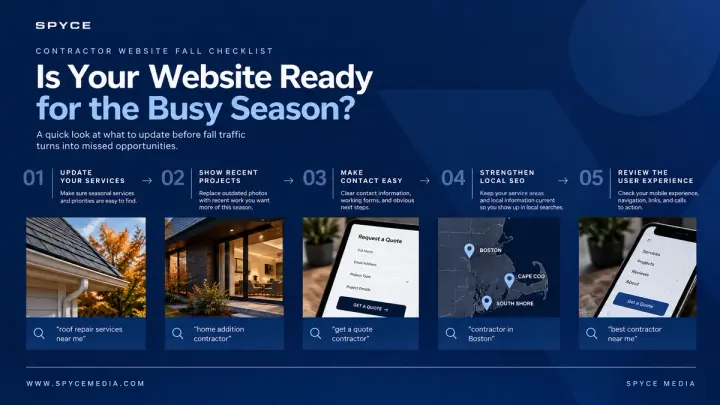
Everything in this article points back to the same idea. Your website should accurately represent the business you're running right now, and it should give every homeowner who finds it a clear, obvious path to reaching out. Current services. Recent projects. Honest, accurate contact information. Calls to action that actually tell people what to do.
None of that is complicated. What it requires is attention, before the season puts your website to the test instead of after.
The strongest seasonal preparation isn't a website overhaul. It's making sure the site you already have is finally working as hard as your business is about to.
Ready to make sure your website can handle the next wave of homeowner inquiries?
A focused review can uncover exactly where your site is falling behind, whether that's outdated services, a stale project gallery, unclear calls to action, or contact information that's quietly costing you leads, before the busy season puts it to the test.
Get your contractor website ready for the busy season before the inquiries start coming in.