

You probably have more marketing content than you think.
Every completed project, customer conversation, positive review, and decision your team makes throughout the day gives people a better understanding of your business. The problem is that most of these moments never make it into your marketing.
You finish a kitchen renovation, take a few photos, and move on to the next job. A homeowner asks a question you've answered a hundred times, but that answer never makes it onto your website. A customer leaves a thoughtful review, and it gets acknowledged before being forgotten.
Meanwhile, your social media calendar is empty again, and you're trying to think of something new to post.
Sound familiar?
Here's something worth considering: you don't always need another marketing idea. You need a better way to recognize, capture, and use the stories already happening inside your business.
Thanksgiving is a good reminder to look at what your business has built throughout the year. Beyond the projects and revenue, there are customers who trusted your team, employees who contributed their skills, and experiences that demonstrate what makes your company worth hiring.
These are valuable marketing assets. When used thoughtfully, they can help potential customers understand your work, recognize your expertise, and feel more confident reaching out.
Let's look at how to put them to use.
1. Your Business Already Has More Content Than You Think
One of the biggest challenges contractors face with marketing is consistency. You know you should be posting, updating your website, and sharing more of your work, but finding the time and ideas can feel like another job on an already full schedule.
This often happens because content creation is treated as a separate activity from running the business.
In reality, your business generates useful content every day.
Think about what happens during a typical week:
- Your team completes a project and documents the finished work.
- A homeowner asks how long a particular service usually takes.
- Someone leaves a review describing their experience.
- Your project manager explains why a specific material was selected.
- Your team solves an unexpected issue on site.
- A customer asks what they should do before work begins.
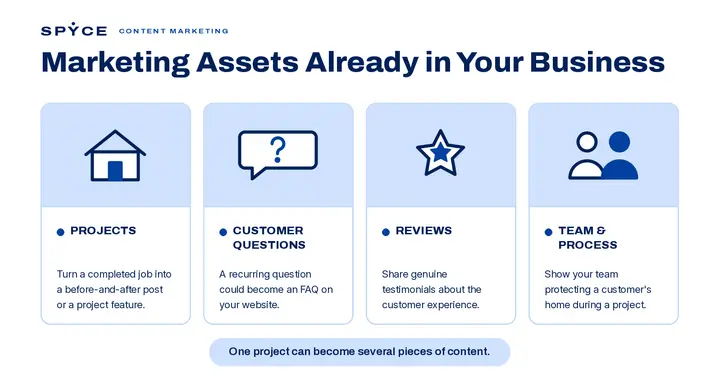
Each of these moments contains information that could help another homeowner.
The difference is learning to recognize which moments are worth sharing and how to communicate them.
There is also an important distinction between posting just to stay active and creating content that demonstrates your company's value. A generic holiday graphic might keep your account looking current, but a real project story can show the quality of your work and explain how your team approaches a job.
Here's the shift: Instead of asking, "What should we post this week?" start asking, "What happened in our business this week that would be useful for a potential customer to know?"
That question gives you a much stronger starting point.
2. Turn Completed Projects Into Stories Worth Sharing
Your completed projects are among your most valuable marketing assets. But if all you share is a finished photo with a caption like "Another project completed," you're leaving much of the story untold.
Homeowners want to see the result, but they also want to understand what went into it.
What was the original problem? What did the customer want to achieve? Were there any challenges? What decisions did your team make along the way?
These details help people understand your experience beyond what a photograph can show.
For example, imagine your company recently completed a kitchen renovation.
You could share a finished kitchen photo, but you could also explain:
- What the homeowner wanted to improve.
- Which parts of the original layout needed attention.
- What materials or design choices were considered.
- How your team approached the project.
- What changed once the work was completed.
That single project can become several different pieces of content.
One post could show the before-and-after transformation. Another could explain a material choice. A short video could walk viewers through the finished space. A website project feature could tell the complete story, including the customer's original goals and the work involved.
The same approach works for roofing, HVAC, remodeling, and other home services.
For example, a roof replacement project could become a post explaining the signs that led the homeowner to consider replacement, a short explanation of the materials used, and a project feature showing the completed work.
The goal isn't to make every project sound extraordinary. It's to provide enough context for people to understand the work and why it matters.
Expert tip: Don't wait until the project is finished to collect content. Capture useful moments throughout the process, while the details are still fresh. A few photos from different stages can tell a much more complete story than one finished-project image.
3. Use Customer Questions as Content Ideas
Your customers are already telling you what information they need. You just need to pay attention.
Think about the questions your team answers during consultations, estimate requests, phone calls, and project discussions.
They might ask:
- How long does this type of project usually take?
- What factors affect the overall cost?
- Do we need to prepare the property before work begins?
- Which materials are suitable for our home?
- What happens if you discover an unexpected issue?
- How do we know whether a repair or replacement is needed?
If one homeowner asks a question, there is a good chance someone else is searching for the same answer.
This makes customer questions an excellent starting point for educational content.
For example, instead of posting a general reminder to contact your company for renovation services, you could explain three factors that influence a renovation timeline. Instead of simply saying you use quality materials, explain why a particular material was selected for a recent project.
The important part is to answer the question clearly.
You don't need to turn every explanation into a technical article. Your audience may not know the industry terminology, and they shouldn't have to understand it to learn something useful.
Explain the issue in everyday language. If the answer depends on the property or requires an inspection, make that clear.
These explanations can also be used beyond social media. A recurring question could become an FAQ on your website, a section on a service page, or a more detailed blog article.
Expert tip: Keep a shared list of questions your team receives. Ask your office staff, estimators, and project managers to contribute. Review the list regularly and prioritize questions that come up repeatedly or relate to services you want to grow.
Over time, you'll have a content resource built around what your customers actually want to know.
4. Let Customer Reviews Tell More of Your Story
Reviews are often treated as something you collect to improve your online reputation. But they can also help potential customers understand what working with your company is like.
Think about the difference between these two messages:
"We provide reliable service."
And a customer review that specifically mentions how your team communicated throughout a project, kept the homeowner informed, and addressed a concern.
The second gives people something concrete to consider.
Your workmanship matters, but so does the experience surrounding it. Homeowners want to know whether your team communicates clearly, respects their property, follows through on commitments, and handles problems professionally.
Customer feedback can help demonstrate these qualities.
Here are a few ways to make better use of your reviews:
- Share genuine testimonials: Highlight specific feedback that communicates something valuable about the customer experience.
- Connect reviews to relevant services: If a customer mentions a roofing project, use that feedback where it supports your roofing service information.
- Respond to reviews: A thoughtful response shows that your business pays attention to customer feedback.
- Use feedback to identify strengths: Notice the qualities customers mention repeatedly. These may be important parts of your company's value that deserve more attention in your marketing.
Remember to keep testimonials authentic. Do not rewrite a customer's words to make a stronger claim or imply that they experienced something they did not mention. Get permission where appropriate before republishing feedback in your marketing materials.
A review is more than a star rating. It is another way to show potential customers what they can expect when they choose your business.
5. Show the People and Process Behind the Work
A finished project can demonstrate what your company produces. Showing the people and process behind it helps explain how your company works.
This matters because hiring a contractor involves more than choosing a finished result. Homeowners are also deciding who they feel comfortable inviting into their property.
You can help answer that concern by showing genuine moments from your team's day-to-day work.
For example:
- Your team preparing and organizing a job site.
- A project manager reviewing plans before work begins.
- Employees explaining a particular installation detail.
- Your team protecting a customer's home during a project.
- A quality check before the job is completed.
- A team member explaining why a specific solution was recommended.
These moments demonstrate care, preparation, and expertise without relying on broad marketing claims.
You can also introduce the people behind the business. Share their roles, experience, or the part they play in delivering a project. Customers may not work directly with every team member, but understanding who is involved can make your company feel more approachable.
Keep this content genuine. You don't need to stage an elaborate behind-the-scenes video or make every employee deliver a scripted message. A short explanation from someone who knows the work can be more effective than a highly produced video that says very little.
The objective is to help customers see the standards and people behind the service.
6. Repurpose One Project Across Multiple Marketing Channels
Once you start collecting project details, customer questions, and team insights, you can get more value from each piece of information.
This is where repurposing becomes useful.
Repurposing doesn't mean copying the same caption across every platform. It means taking one useful source of information and presenting different parts of it in formats that make sense for different channels.
Let's return to the kitchen renovation example.
You could turn that one project into:
- A before-and-after social post: Show the transformation and explain the homeowner's original goal.
- An educational carousel: Explain one important decision made during the renovation.
- A short video: Walk viewers through a detail of the finished space.
- A website project feature: Share the complete story, from the original requirements to the finished result.
- A customer testimonial post: Highlight genuine feedback about the experience.
- An FAQ: Answer a question that came up during the project.
- An email update: Share the completed project and link readers to the relevant service page.
Each piece has a different purpose.
Social media can introduce the project and encourage people to learn more. Your website can provide the fuller explanation and show how the work connects to a particular service. An email can share a useful update with people who already know your business.
This is also why your website and social media should work together. When a post introduces a service or project, give interested readers somewhere useful to go next.
For example, link a roofing project feature to your roofing service page rather than sending every visitor to your homepage.
A thoughtful repurposing process helps you stay consistent while making better use of the content your team has already created.
7. Build a Simple System for Collecting Content
Having good content opportunities is one thing. Making sure they don't get lost is another.
If project photos are scattered across employees' phones, customer feedback is saved in different places, and nobody knows who is responsible for sharing updates, consistency will always be difficult.
You don't need a complicated content management system to fix this. Start with a simple process.
Create a project documentation routine.
Decide which photos should be captured during each project. Depending on the work, this may include the original condition, preparation, progress, important details, and finished result.
Keep basic project notes.
Record the service performed, the customer's goal, any important decisions, and the final outcome. These details will make writing captions and project stories much easier later.
Assign responsibility.
Decide who collects photos, who uploads them, who checks customer permissions, and who prepares the content. Make sure everyone understands their part.
Organize your content library.
Create folders by project or service type. Keep approved photos, testimonials, and project information together so they are easy to locate when needed.
Protect customer privacy.
Always consider what is visible in photographs and what information can be shared. Get permission before publishing customer property, identifying details, or testimonials where appropriate.
The most important thing is consistency. A simple routine that your team follows every week is more valuable than an elaborate system that nobody has time to maintain.
8. Turn Existing Business Activity Into Consistent Marketing
You don't need to transform every project or customer interaction into a marketing campaign. Start with what you already have.
Set aside time to review your existing materials:
- Look through recent project photos and identify jobs worth featuring.
- Review customer feedback and note recurring positive comments.
- List questions your team regularly receives.
- Identify employees who can explain useful aspects of your services.
- Find project details that demonstrate the quality and care behind your work.
Choose a few opportunities and build your next content schedule around them.
For example, one week could feature a completed project. The next could answer a common customer question. Another could highlight a team member or explain an important part of your process.
You don't need to post about everything. Choose the information that is most relevant to your customers and the services you want to promote.
Pay attention to how people respond, too. Notice which posts generate questions, saves, shares, website visits, or relevant inquiries. These signals can help you understand what your audience finds useful.
This is what makes content marketing for contractors more sustainable. Instead of constantly starting from a blank page, you're building a library of useful information from the work your company already does.
Your Best Marketing Stories May Already Be Happening
As the year comes to a close, take a moment to look beyond the projects completed and the numbers achieved.
Think about the customers who trusted your team, the employees who contributed their expertise, the problems you helped solve, and the work you're proud to put your name on.
Those experiences are worth sharing.
Your marketing doesn't always need a new campaign, a trend, or another idea pulled from somewhere else. It needs a consistent way to capture the value already happening inside your business and communicate it to the people who may need your services.
Start with one project. One customer question. One review. One moment that shows how your team works.
Then build from there.
At SPYCE Media, we help contractors turn their projects, expertise, and customer experiences into purposeful marketing content. If you have great work happening behind the scenes but struggle to communicate it online, let's build a content strategy that makes better use of what your business already has.