

Why Better Reviews Don't Always Mean Better Rankings
You've built a solid reputation. Your customers are happy, your projects speak for themselves, and you've collected plenty of positive Google reviews.
So why is another contractor showing up ahead of you on Google?
They might have fewer reviews. Their rating might be slightly lower. Their website might not look as polished as yours. Yet when someone searches for a contractor in your area, their business appears near the top while yours is several positions down.
It's frustrating, especially when you know the quality of your work is just as good, if not better.
But here's something worth understanding: Google doesn't rank businesses based on customer reviews alone.
Reviews are an important part of your online reputation, and they can contribute to how prominently your business appears in local search. However, Google considers several other factors when deciding which businesses are relevant to a search.
These include how closely your business matches what someone is looking for, how close you are to the person searching, and how established your business appears online.
Your website also plays an important role. It helps Google understand what services you offer, which locations you serve, and whether your content answers the questions potential customers are asking.
This means a contractor with fewer reviews could still have a stronger overall local SEO presence.
If you've been wondering, "Why does my competitor rank higher than me on Google?", the answer may have less to do with your reviews and more to do with what's happening across your website and online presence.
Let's look at the factors worth paying attention to and, more importantly, what you can do about them.
1. How Google Determines Which Businesses Appear in Local Search
Before you start changing your website or investing more time in collecting reviews, it's helpful to understand how Google approaches local search.
When someone searches for a service like "kitchen remodeling contractor near me" or "roof repair in Boston," Google tries to show businesses that are most likely to meet that person's needs.
According to Google's guidance, local search results are primarily influenced by three factors:
- Relevance
- Distance
- Prominence
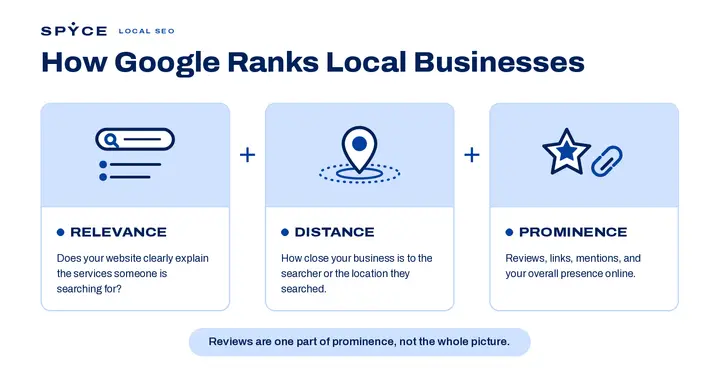
Understanding these local SEO ranking factors gives you a much better starting point for improving your visibility.
Relevance: Does Your Business Match What Someone Is Searching For?
Relevance refers to how well your business matches the searcher's needs.
For example, imagine someone searches for:
- Bathroom remodeling contractor
- Emergency plumbing services
- Custom home builder
- Kitchen renovation company
- Roof replacement contractor
Google needs to understand which businesses actually provide those services.
If your website simply says that you offer "quality home improvement services," it may not give search engines enough specific information about the individual services you provide.
Compare that with a website that has dedicated pages explaining its bathroom remodeling, kitchen renovation, and home addition services.
The second website gives both Google and potential customers a much clearer picture of what the business does.
This doesn't mean you should repeat the same keywords everywhere. It means your website should accurately and clearly describe your services, the problems you solve, and the types of projects you take on.
What this means for your business: Make sure your website communicates exactly what you offer. Don't assume Google will understand every service simply because it's listed in a short paragraph or included in a navigation menu.
Distance: How Close Is Your Business to the Person Searching?
Distance refers to how far your business is from the location of the person searching, or from the location specified in their search.
This is particularly important for contractors and home service businesses because most customers are looking for someone who works within a specific geographic area.
For example, a homeowner searching for a remodeling contractor in Quincy may see different local businesses than someone searching from Plymouth.
Even if your business has more reviews and a stronger website, a competitor located closer to the searcher may appear higher in certain local results.
This is one factor you cannot always control.
You can't simply tell Google to show your business in every nearby town, and adding more city names to your website won't automatically make you more visible in those locations.
However, you can make your service areas clearer.
Identify the communities you genuinely serve, explain where your team works, and create useful location-specific information when it makes sense.
What this means for your business: Make sure your website and Google Business Profile accurately reflect your business location and service areas. Focus on the locations you actually serve rather than trying to appear everywhere.
Prominence: How Established and Recognized Is Your Business Online?
Prominence refers to how well-known and established a business appears.
This is where your online presence becomes particularly important.
Google may consider information such as reviews, ratings, links from other websites, and other signals that help establish a business's reputation and recognition.
Think about two contractors operating in the same area.
Both offer similar services, but one has:
- A well-developed website with detailed service pages.
- Consistent business information across online directories.
- Mentions and links from relevant local websites.
- Recent project photos and examples of completed work.
- Helpful articles that answer common homeowner questions.
- A complete and actively maintained Google Business Profile.
The other contractor has a good rating and plenty of reviews but very little information available elsewhere online.
The first contractor may have a stronger overall online presence, even if the second has more reviews.
This is why collecting reviews should be part of your local SEO strategy, not the entire strategy.
What this means for your business: Build a recognizable online presence beyond Google reviews. Your website, project content, local mentions, and business information should all help establish your credibility.
2. Your Competitor May Have More Relevant Service Pages
Here's something we often encourage contractors to look at first: their website's service pages.
You might offer ten different services, but does your website actually explain each one?
Many contractor websites have a single page called "Services" that lists everything the business does. It might include a few sentences about remodeling, roofing, additions, repairs, and other work.
That page may be enough for someone who already knows your business. But it may not be enough to compete for the different searches homeowners use when looking for specific services.
Why Dedicated Service Pages Matter
Think about how homeowners search.
Someone looking for a kitchen renovation isn't necessarily going to search for a general contractor. They might search for:
- Kitchen remodeling contractor in [City]
- Kitchen renovation company near me
- Kitchen remodeling services in [Location]
- Custom kitchen renovation contractor
These searches show a specific need.
A dedicated kitchen remodeling page gives you the opportunity to address that need directly.
Instead of squeezing all your services into one generic page, you can create individual pages that explain:
- What the service involves.
- What types of projects you handle.
- Which materials, methods, or solutions you offer.
- What homeowners should consider before starting.
- What your typical project process looks like.
- Which locations you serve.
- How someone can request an estimate or consultation.
For example, consider the difference between these two approaches.
A generic services page:
"We provide home remodeling services, including kitchen renovations, bathroom remodeling, and home additions. Contact us to learn more."
A dedicated kitchen remodeling page:
"Planning a kitchen renovation in [City]? We help homeowners rethink their kitchen layouts, improve functionality, update finishes, and create spaces that work better for everyday living. From initial planning to the final details, our team guides you through the remodeling process."
The second example gives potential customers more context. It also provides search engines with clearer information about the specific service being offered.
What Should a Strong Contractor Service Page Include?
A useful service page should do more than mention a keyword. It should help a potential customer understand whether your business is the right fit.
Consider including:
- A clear service headline. Tell visitors exactly what service you provide and, where appropriate, the location you serve.
- A detailed service description. Explain what the work involves, what problems you solve, and what makes your approach different.
- Your process. Walk homeowners through what happens when they work with you, from the initial conversation to project completion.
- Relevant project photos. Show examples of work that demonstrate your experience and the quality of your results.
- Frequently asked questions. Address concerns about timelines, planning, materials, costs, and what customers should expect.
- Customer testimonials. Include relevant feedback that helps visitors feel more confident about contacting you.
- A clear next step. Make it easy to request an estimate, schedule a consultation, or contact your team.
One important thing: don't create service pages just to have more URLs on your website.
If two pages offer almost identical information, they're unlikely to provide much additional value. Each page should have a clear purpose and answer a distinct customer need.
Expert takeaway: Your service pages should work like individual entry points into your business. A homeowner searching for kitchen remodeling should be able to land directly on a page that speaks to kitchen remodeling, not have to figure out what you offer from a general services list.
3. Location Signals May Be Stronger on Their Website
Let's say you offer kitchen remodeling, bathroom renovations, and home additions.
You operate in several communities, but your website only mentions your main business location on the contact page.
Meanwhile, your competitor has clearly explained the areas they serve throughout their website.
That difference could matter.
Local search is heavily connected to geography. Google needs to understand where your business is located and which customers or communities your services are relevant to.
Make Your Service Areas Clear
Start by reviewing your website.
Can someone quickly identify where you work?
Your service areas should be easy to find, whether they're included on your homepage, service pages, contact page, or a dedicated service area page.
For example:
"We provide kitchen remodeling and home renovation services throughout Boston, Quincy, Milton, and surrounding South Shore communities."
This gives visitors useful information and helps communicate your geographic focus.
However, simply adding a list of city names to every page isn't a local SEO strategy.
Your location information should feel natural and provide real context.
Should You Create Location-Specific Service Pages?
In some cases, yes.
If you genuinely serve multiple locations and have enough useful information to make each page meaningful, location-specific pages can help you address searches in those communities.
For example:
- Kitchen Remodeling in Quincy, MA
- Bathroom Remodeling in Milton, MA
- Home Additions in Hingham, MA
But here's where contractors need to be careful.
Creating dozens of pages that only replace the city name while keeping the rest of the content identical can create a poor experience for visitors. These pages may also be considered doorway pages if they're created primarily to capture search traffic rather than provide useful information.
Instead, make each location page genuinely helpful.
Include information that reflects your work in that area, relevant project examples, the services you provide there, and details that help homeowners understand how you work.
If you don't have meaningful information to add to a separate page, a well-written service area section may be the better option.
Check Your Business Information for Consistency
Your business name, address, phone number, and other details should be accurate wherever your business appears online.
Review your:
- Website contact information.
- Google Business Profile.
- Relevant business directories.
- Local association listings.
- Social media business profiles.
This doesn't mean every minor formatting difference will automatically damage your rankings. The goal is to make sure customers and search engines can confidently identify the same business across the web.
What this means for your business: Don't just tell Google what you do. Make it clear where you do it, too. Strong local relevance comes from accurate business information and genuinely useful location context.
4. Their Google Business Profile May Be Better Optimized
Your website isn't the only place where Google learns about your business.
Your Google Business Profile is another important part of your local search presence.
It's often one of the first things homeowners see when searching for contractors. It can display your business name, phone number, website, reviews, photos, services, hours, and other useful information.
If your competitor has a more complete and accurate profile, they may be doing a better job of communicating what their business offers.
Start With Your Primary Business Category
Your primary category helps Google understand what type of business you operate.
For example, a business primarily focused on kitchen remodeling should choose the most accurate available category for that business.
You can also add relevant additional categories when they accurately describe your services.
Don't choose categories simply because you want to rank for more searches. Your categories should reflect what your business actually does.
Add Accurate Service Information
Take a look at the services listed on your profile.
Do they reflect the work you currently offer?
If you've expanded your services or changed your focus, make sure your profile reflects that.
Accurate service information helps potential customers understand whether you can handle their project before they even visit your website.
Keep Your Photos Current
For contractors, photos can be especially valuable.
Homeowners want to see the quality of your work before inviting someone into their home or requesting a consultation.
Consider adding:
- Before-and-after project photos.
- Completed kitchens and bathrooms.
- Exterior renovations.
- Home additions.
- Work-in-progress images.
- Photos of your team, where appropriate.
Use real images from your projects whenever possible. They provide a more credible representation of your work than generic stock photography.
You don't need to upload something every day. Focus on keeping your profile accurate and giving potential customers a useful picture of your business.
Don't Ignore Your Reviews
Yes, reviews still matter.
Encourage satisfied customers to share honest feedback, and take the time to respond to reviews, both positive and negative.
A thoughtful response shows that you value customer feedback and are engaged with your business reputation.
Avoid offering incentives in exchange for reviews or trying to control what customers write. Reviews should reflect genuine customer experiences and comply with Google's policies.
Keep Your Profile Updated
Check that your phone number, hours, website link, address or service area, and business details are accurate.
If your business changes its operating hours or contact information, update your profile.
An outdated profile can create unnecessary friction for potential customers. Imagine someone trying to call your business using an old number or visiting an incorrect address.
That isn't just a visibility problem. It's a missed opportunity.
Important: A complete Google Business Profile does not guarantee a higher ranking. It helps Google and potential customers understand your business, but local visibility still depends on multiple factors, including relevance, distance, and prominence.
5. Their Website May Have Stronger Content and Authority
Let's move beyond the basics.
Your competitor might have a better-developed website that does more than list services and display a phone number.
It might answer common homeowner questions, explain the renovation process, showcase completed projects, and demonstrate knowledge of the industry.
This matters because people rarely hire a contractor based on one search result alone.
They research. They compare. They look at photos. They read reviews. They visit websites and try to determine which company they can trust with their project.
Your website should support that decision.
Useful Content Helps You Reach Customers Earlier
Imagine a homeowner planning a bathroom renovation.
They're not necessarily ready to contact a contractor today. They may still be researching:
- How much does a bathroom renovation cost?
- How long does a bathroom remodel take?
- What should I consider before renovating my bathroom?
- Should I replace my bathtub or install a walk-in shower?
- What are common bathroom remodeling mistakes?
If your website has useful articles that answer these questions, you have an opportunity to reach that homeowner earlier in their decision-making process.
This is where a well-planned blog becomes valuable.
Rather than publishing random articles, focus on topics connected to your services and the questions your ideal customers are already asking.
For example:
- How Much Does a Kitchen Remodel Cost?: Reaches homeowners researching project budgets
- 7 Things to Consider Before Building a Home Addition: Helps homeowners plan before contacting contractors
- How Long Does a Bathroom Renovation Take?: Answers a common project planning question
- What to Look for When Hiring a General Contractor: Builds trust with homeowners comparing providers
- Kitchen Remodeling Trends That Improve Everyday Functionality: Attracts homeowners exploring renovation ideas
The goal isn't to publish as many articles as possible.
It's to publish genuinely useful information that demonstrates your experience and helps potential customers make informed decisions.
Project Pages Can Be Just as Valuable as Blog Posts
For contractors, your completed work is one of your strongest marketing assets.
A project gallery is a good start, but you can get more value by turning individual projects into detailed case studies.
Instead of simply uploading ten photos of a finished kitchen, explain:
- What the homeowner wanted to achieve.
- What challenges the project involved.
- What improvements were made.
- Which materials or design decisions were important.
- What the finished space accomplished.
For example, a project page could be titled:
"Kitchen Renovation in Hingham, MA: Creating a More Functional Family Space"
This gives visitors a better understanding of your capabilities while adding meaningful context around your work.
It also creates an opportunity to naturally include relevant service and location information.
Just make sure your project descriptions are accurate. Don't invent project details or claim experience in a location or service category that you haven't actually worked in.
What About Backlinks and Online Mentions?
Another factor worth investigating is your website's authority.
A backlink is a link from another website to yours.
For example, your business might be mentioned by:
- A local home improvement publication.
- A supplier or industry partner.
- A professional association.
- A local business organization.
- A publication featuring one of your completed projects.
Relevant links and mentions can help establish your business's presence and credibility online.
However, not all backlinks are equally valuable.
Buying large quantities of low-quality links, participating in link schemes, or creating irrelevant directory listings isn't a sustainable SEO strategy.
Focus on legitimate opportunities to earn relevant mentions.
You might contribute expert advice to a local publication, collaborate with complementary businesses, share a noteworthy project with an industry publication, or participate in local community initiatives.
Expert takeaway: Your website shouldn't just prove that your business exists. It should demonstrate why someone should consider hiring you. Helpful content, detailed project examples, and credible online mentions all contribute to a stronger digital presence.
6. Technical Website Health Could Be Holding You Back
Here's something contractors often overlook.
Your website might look great, but that doesn't necessarily mean it's performing well from an SEO perspective.
A visually attractive website can still have technical problems that make it harder for search engines to crawl, understand, and index its content.
It can also create a frustrating experience for potential customers.
Let's look at a few areas worth checking.
Page Speed and Loading Performance
How quickly does your website load?
Imagine a homeowner searching for a contractor on their phone. They click your website, but the homepage takes several seconds to load.
They might leave before seeing your work or learning what services you offer.
Slow-loading pages can affect the user experience, and Google's Core Web Vitals provide measurable ways to assess important aspects of loading performance, interactivity, and visual stability.
A few things to review:
- Are your images unnecessarily large?
- Are you using more scripts or plugins than necessary?
- Are animations affecting how quickly the page becomes usable?
- Does the website load efficiently on mobile devices?
- Are there unnecessary redirects?
Large project photos are common on contractor websites, and understandably so. You want visitors to see the quality of your work.
But those images should be properly sized and compressed without sacrificing too much visual quality.
Mobile Usability
A large portion of local searches happen on mobile devices.
Your website should be easy to navigate on a smaller screen.
Check whether:
- Text is readable without zooming.
- Buttons are easy to tap.
- Phone numbers are clickable.
- Navigation menus work properly.
- Images display correctly.
- Contact forms are easy to complete.
- Important information isn't hidden or difficult to find.
Think about the experience from the homeowner's perspective.
If someone is standing in their kitchen, thinking about a renovation, and searching for a contractor on their phone, can they quickly understand what you do and contact you?
If not, your website may be creating unnecessary barriers.
Crawlability and Indexability
Google needs to discover and access your website's content before it can consider showing those pages in search results.
This is where crawling and indexing come in.
Crawling is the process of discovering and accessing website pages. Indexing is the process of analyzing and storing information about those pages so they can potentially appear in search results.
A few technical issues can interfere with this process:
- Important pages accidentally blocked from crawling.
- Pages marked with a noindex directive.
- Broken internal links.
- Incorrect canonical tags.
- Pages that aren't included in your XML sitemap.
- Redirects that lead to the wrong destination.
For example, you might have created a detailed bathroom remodeling page, but if it's accidentally marked as noindex, Google may not include it in search results.
This is why technical SEO matters.
You can write excellent content and create beautiful service pages, but those efforts won't deliver their intended search visibility if important pages cannot be properly accessed or indexed.
Website Structure and Internal Links
Your website should have a logical structure.
For example:
- Homepage
- Services
- Kitchen Remodeling
- Bathroom Remodeling
- Home Additions
- Projects
- About
- Blog
- Contact
- Services
This helps visitors navigate your website and gives search engines a clearer understanding of how your content is organized.
Internal links are also important.
If you publish a blog post about kitchen renovation planning, you can link naturally to your kitchen remodeling service page.
If you publish a project case study, you can link to the relevant service page.
These connections help visitors discover related information and help search engines understand the relationship between your pages.
What this means for your business: Don't evaluate your website based on appearance alone. A strong contractor website should be visually professional, technically accessible, easy to use, and structured around the services customers are searching for.
7. What to Review Before Trying to Outrank a Competitor
Now that you understand the different factors influencing contractor Google rankings, it's time to look at your own online presence.
Before investing more time in collecting reviews or making random website changes, conduct a simple competitor comparison.
You don't need expensive SEO software to identify your first few opportunities.
Start with these areas.
1. Compare Your Service Pages
Search for your main services and look at the businesses appearing ahead of you.
Ask yourself:
- Do they have dedicated pages for individual services?
- Are their service descriptions more detailed?
- Do they explain their project process?
- Do they include relevant project photos?
- Do they answer common homeowner questions?
- Is it easy to request an estimate?
Then compare those pages with your own.
You're not looking to copy your competitor's content. You're looking for gaps in the information your website provides.
If their kitchen remodeling page answers questions your website doesn't address, that's an opportunity to improve your own page.
2. Review Their Local Information
Check how clearly your competitor communicates the locations they serve.
Look at:
- Their Google Business Profile.
- Their business address or service area.
- The locations mentioned on their website.
- Their location-specific project examples.
- Their contact information.
Then review your own business information.
Are your service areas accurate? Can potential customers easily determine whether you work in their community?
3. Compare Your Google Business Profiles
Look beyond the review count.
Check whether your competitor has:
- The correct primary business category.
- Relevant additional categories.
- Accurate service information.
- Current business hours.
- Recent, genuine project photos.
- A working website link.
- Complete contact information.
Also consider the quality and relevance of their reviews.
Do customers mention particular services, project experiences, or locations? Are the reviews recent?
Don't assume that a higher review count automatically means a better-optimized profile.
4. Look at Their Website Content
Visit their website and explore more than the homepage.
Check whether they have:
- Detailed service pages.
- Helpful blog articles.
- Completed project case studies.
- Frequently asked questions.
- Clear calls to action.
- Relevant internal links.
- Useful information about their team and experience.
Ask yourself one simple question:
If I were a homeowner comparing these two businesses, which website would help me make a more informed decision?
That question can reveal opportunities that a basic keyword comparison might miss.
5. Check Your Technical SEO
Use tools like Google Search Console and PageSpeed Insights to review your website's performance.
In Google Search Console, you can investigate:
- Which pages are indexed.
- Which search queries are generating impressions and clicks.
- Whether important pages have indexing issues.
- Which pages are receiving organic traffic.
- Whether your search visibility is changing over time.
PageSpeed Insights can help you understand your website's loading performance and identify areas for improvement.
You can also use Google's Rich Results Test when you need to check whether eligible structured data is being detected correctly.
You don't have to become an SEO specialist to start reviewing these areas. The important thing is to identify what might be limiting your website and prioritize improvements based on evidence.
6. Compare the Actual Search Results
One final point: make sure you're comparing the same search.
Search results can vary depending on the searcher's location, the search phrase, the device, and other contextual factors.
A competitor might appear ahead of you for "kitchen remodeling contractor in Boston" but not for "bathroom renovation contractor in Quincy."
Those are different searches with different competitive landscapes.
Also distinguish between the local map results (often called the local pack) and the regular organic website listings. They're related, but they don't work in exactly the same way.
Track your most important service and location combinations separately.
This gives you a much more accurate picture of where your business is visible and where it needs improvement.
8. Building Visibility Beyond Your Reviews
At this point, you might be thinking that there's a lot more to local SEO than you originally expected.
And there is.
But that doesn't mean you need to fix everything at once.
The most effective approach is to build a stronger online presence one improvement at a time.
Here is where we'd recommend starting.
First, Strengthen Your Most Important Service Pages
Start with the services that matter most to your business.
If kitchen remodeling is one of your primary revenue drivers, make sure that page is detailed, useful, and easy to navigate.
Explain what you offer, show relevant projects, answer customer questions, and make it clear how someone can get started.
Prioritize quality over the number of pages you publish.
Next, Make Your Local Presence Clearer
Review your Google Business Profile and website information.
Make sure your business details are accurate and that your service areas are clearly communicated.
If you have meaningful project examples from specific communities, consider showcasing them on your website.
You want potential customers to recognize that you work in their area and understand the services you provide.
Build Content Around Real Customer Questions
Your customers are already asking questions during consultations, phone calls, and estimate requests.
Those questions can become the foundation of your content strategy.
For example, if homeowners frequently ask how long a renovation takes, create a helpful article explaining the factors that influence project timelines.
If they ask what to prepare before a consultation, write a guide that walks them through the process.
This type of content can support your SEO efforts while helping potential customers feel more prepared before contacting you.
Make Your Website Easier to Use
Review your website from a customer's perspective.
Can someone find your phone number quickly? Are your services easy to understand? Do your project photos load properly? Is it clear what they should do next?
Sometimes improving your website isn't about adding more content or changing the design.
It's about removing friction.
A well-structured website should make it easy for the right customer to move from researching your business to contacting your team.
Monitor Your Progress
SEO is not a one-time project.
After making improvements, monitor how your website performs.
Pay attention to:
- Organic impressions and clicks.
- Search queries bringing visitors to your website.
- Performance of individual service pages.
- Local visibility for important searches.
- Website inquiries and phone calls.
- Google Business Profile interactions.
Remember that more website traffic isn't automatically better.
You want to attract people who are actually looking for the services you provide, in the locations you serve.
A smaller number of qualified visitors can be more valuable than a large amount of traffic from people who are unlikely to become customers.
9. Your Reviews Are Valuable. Your Website Needs to Support Them.
Let's go back to where we started.
You have good reviews. Your customers are happy. You know your team does quality work.
But when homeowners search for your services, your competitor keeps appearing ahead of you.
It's easy to assume you need more reviews.
And while continuing to build your reputation is important, it may not be the only thing your business needs.
Your reviews help communicate what previous customers think about working with you. Your website helps explain what you do, where you work, what makes your services valuable, and why someone should consider hiring you.
Your Google Business Profile helps establish your presence in local search. Your content answers customer questions. Your project pages demonstrate your experience. Your technical SEO makes it easier for search engines to access and understand your website.
All these elements work together to support your online visibility.
The goal isn't simply to have more reviews than your competitor. It's to build an online presence that makes your business easier to find, understand, and trust.
Because having an excellent reputation is only part of the equation. The right customers also need to be able to find you.
Is Your Website Helping You Compete in Local Search?
If your business has great reviews but isn't getting the local visibility or website inquiries you expected, it may be time to look beyond your Google Business Profile.
At SPYCE, we help home service businesses strengthen their online presence through strategic website design, SEO, and marketing.
We can help identify gaps in your website, review how your services are presented, and uncover opportunities to improve your local search visibility.
Want to understand what's keeping your website from showing up in local searches?
Let's take a closer look at your online presence and find out where you can improve.